
This Article covers:
Click a title to scroll down to that section
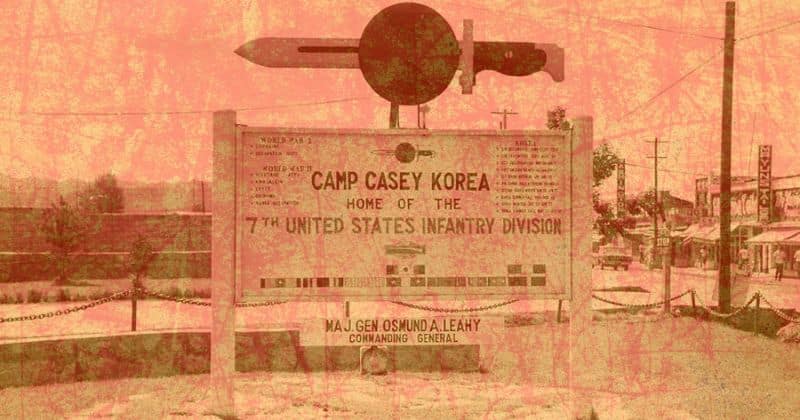
Being told that time spent stationed at Camp Casey does not qualify for the VA’s Agent Orange presumption is discouraging, but veterans can still prove exposure. Agent Orange was sprayed along the Korean DMZ a short drive north of the base, the Army has admitted it in writing, and Camp Casey veterans can win their claims by showing they served in or near the DMZ.
- Camp Casey sits just over 10 miles south of the DMZ; the Army acknowledged in 1996 that the base was “located in the area of the DMZ.”
- The Department of Defense documented tactical-herbicide application in the area from April 1968 through July 1969, but assignment to Camp Casey alone does not establish Agent Orange exposure.
- Veterans may still establish eligibility by showing their unit operated in or near the DMZ, documenting temporary-duty assignments, or proving actual exposure.
- A negative military records search does not necessarily end the claim. Additional evidence such as personnel records, TDY orders, unit histories, maps, and credible lay statements may still support exposure.
- Once qualifying exposure is established, VA may presume service connection for certain Agent Orange-related conditions. For conditions not on the presumptive list, veterans require a medical nexus opinion.
Was Agent Orange Used at Camp Casey?
Agent Orange and other tactical herbicides were used near Camp Casey, along the southern edge of the Korean DMZ. However, available records do not establish that Agent Orange was routinely sprayed throughout Camp Casey or that every veteran stationed there was exposed.
Camp Casey is in Dongducheon, south of the DMZ. The installation served as a major garrison for the 2nd Infantry Division and supported units that trained, patrolled, and performed duties closer to the DMZ.
Is Camp Casey in the Korean DMZ itself?
No. Camp Casey is not inside the DMZ. Army sources have described the installation as roughly 11 miles south of the zone. Its location still matters because many units based at Camp Casey performed duties, training, patrols, or temporary assignments farther north.
A 1996 Army letter referenced in a Board of Veterans’ Appeals decision stated that approximately 21,000 gallons of Agent Orange were used in Korea during 1968 and 1969. The letter also described Camp Casey as being “located in the area of the DMZ.”
Department of Defense records show that tactical herbicides were applied near the Korean DMZ from April 1968 through July 1969. The military used them to clear vegetation and improve visibility along defensive positions.
This history helps explain why a Camp Casey veteran may have a valid exposure claim. However, it does not mean everyone assigned to the base was exposed.
Does Being Stationed at Camp Casey Automatically Qualify Veterans for Agent Orange Benefits?
VA does not automatically presume herbicide exposure for every veteran who served at Camp Casey. To receive the Korea DMZ exposure presumption, the evidence must show that the veteran served in or near the Korean DMZ during the qualifying period.
Current VA guidance also looks at whether the veteran’s unit operated in the DMZ area and whether the veteran was physically present there. A veteran may establish eligibility in several ways:
- Service in a unit VA and DoD recognize as having operated in or near the DMZ
- Service records showing that an unlisted unit performed duties in or near the DMZ
- Temporary-duty, training, patrol, maintenance, transportation, or support assignments in the covered area
- Direct evidence showing actual contact with tactical herbicides
50% of Camp Casey-Related Disability Appeals at the BVA Were Granted
With the right evidence, Camp Casey claims can be won, even when previously denied. Hill & Ponton reviewed the Board of Veterans’ Appeals decisions from 2021 to 2025 involving veterans who claimed Agent Orange or herbicide exposure related to Camp Casey and found that 50% of the issues claimed were granted.
The winning claims usually included proof that the veteran served near the DMZ, traveled to or from the DMZ, performed duties near the DMZ, handled vehicles or equipment from the DMZ, or gave credible statements explaining how exposure occurred.
What Are the Qualifying Dates for Korea DMZ Agent Orange Exposure?
Federal law recognizes service in or near the Korean DMZ from Sept. 1, 1967, through Aug. 31, 1971. 38 C.F.R. § 3.307(a)(6)(iv) initially covered the period of April 1, 1968, through Aug. 31, 1971, for units determined by DoD to have operated in or near the DMZ.
Congress added 38 U.S.C. § 1116B through the Blue Water Navy Vietnam Veterans Act of 2019. The statute expanded the start date to Sept. 1, 1967, and does not expressly require assignment to a named unit.
This difference matters for veterans who arrived in Korea between Sept. 1, 1967, and March 31, 1968. A denial based only on the regulation’s later start date may overlook the controlling statute.
The documented tactical-herbicide application period ended in July 1969, but the statutory eligibility period continues through Aug. 31, 1971. Veterans who arrived after spraying stopped may still qualify under the presumption if they meet the statutory service requirements.
What if You Served After Aug. 31, 1971?
Service after the statutory window does not qualify for the Korea DMZ exposure presumption. A veteran may still pursue direct service connection, but the evidence must establish actual exposure rather than rely on the date-and-location presumption.
Case Example
In a 2025 Board of Veterans Appeals decision (BVA Citation Nr. A25016735, Feb. 25, 2025), the Board granted service connection to a Camp Casey veteran who served in Korea in 1972 after resolving reasonable doubt in his favor.
The veteran established that his duties as a voice radio operator brought him within two to three miles of the DMZ and submitted scientific evidence that herbicide chemicals persist in soil.
A VA decision in one case is not binding on other claims. It does not create an automatic residual-soil presumption for veterans who served after August 1971. A later service claim needs evidence specific to the veteran’s duties, location, and alleged contact, and could require legal assistance.
What If the Unit Is Not on VA’s Korea DMZ Agent Orange List?
A unit missing from the recognized list does not necessarily end the claim. It means the veteran will need to prove where the unit operated rather than rely on VA’s existing recognition.
Support, signal, medical, maintenance, transportation, and military police units have often performed duties near the DMZ even when their main headquarters remained at Camp Casey.
Use the Federal Statute
Under 38 U.S.C. § 1116B, the key requirement is service in or near the Korean DMZ between Sept. 1, 1967, and Aug. 31, 1971.
The statute does not restrict the presumption to a published list of unit names. However, unit records often provide the evidence needed to show that the veteran actually served in or near the DMZ. Keep in mind that a record showing only assignment to Camp Casey may not suffice.
Prove Where the Unit Operated
A veteran can submit records showing that an unlisted unit sent personnel into the DMZ area (and the VA has a duty to help obtain relevant federal records when the veteran provides enough information to identify them). Useful evidence includes:
- Morning reports
- Unit histories
- Operational reports
- Temporary-duty orders
- Travel vouchers
- Patrol or guard rosters
- Maintenance and supply records
- Training schedules
- Maps showing duty sites
- Performance evaluations describing assignments
- Buddy statements from members of the same unit
Prove Actual Exposure Directly
A veteran who does not meet the presumptive requirements may still establish direct service connection under 38 C.F.R. § 3.303.
According to Combee v. Brown, the absence of a presumption does not prevent a veteran from proving causation. The veteran must show actual exposure, a current disability, and a medical connection between the two.
Different theories may be argued together. A veteran can assert the statutory presumption while also presenting evidence of direct exposure to Agent Orange as an alternative if the presumption doesn’t apply.
What Evidence Do You Need to Prove Agent Orange Exposure at Camp Casey?
Service Personnel Records
Request the complete Official Military Personnel File, not just DD-214, and look for details that establish duties in or near the DMZ. Personnel records will show:
- The unit and subordinate unit
- Dates of service at Camp Casey
- Military occupational specialty
- Temporary-duty assignments
- Training locations
- Awards or evaluations tied to forward duty
- Transportation or maintenance responsibilities
- Assignments to patrol, guard, communications, or medical support
Unit and Operational Records
Unit histories often provide information that individual personnel records do not. Morning reports, operational reports, command chronologies, duty rosters, maps, and training records could show that a unit stationed at Camp Casey regularly sent personnel north.
Older decisions sometimes refer to records research by the Joint Services Records Research Center (JSRRC). Current claims may use different military records research channels, but the purpose remains the same: determine whether official records support the claimed location and duties.
Can You Still Qualify After a Negative Records Search?
A response stating that researchers found no documentation does not always prove that an event never occurred. It means the reviewed records did not confirm it.
Do not stop at a generic negative research response. Identify whether VA searched the correct company, battalion, regiment, subordinate unit, dates, alternate unit names or designations dates, temporary duty locations, and operational records.
A negative response may still carry significant weight, so it should not be dismissed. The veteran can respond with more precise records, credible statements, maps, and other evidence.
If the positive and negative evidence reach an approximate balance, VA must apply the benefit-of-the-doubt rule under 38 C.F.R. § 3.102.
Temporary-Duty and Travel Records
Temporary-duty orders can become critical when a veteran’s permanent unit does not appear on the recognized list. Travel vouchers, pay records, evaluations, and unit logs may help confirm those assignments. Look for records showing travel to:
- Guard posts
- Patrol areas
- Communications sites
- Field hospitals
- Maintenance locations
- Artillery or training positions
- Supply points
- Forward command posts
Personal Statements
Veterans may submit a sworn statement describing what they personally saw and experienced. Include details such as:
- The roads, fence lines, or areas where spraying occurred
- Spray trucks, backpack sprayers, drums, or other equipment you observed
- Browned or dead vegetation
- Chemical smells
- Your distance from the activity
- How often the contact occurred
- Whether you handled vegetation, soil, equipment, or clothing
- Names of other service members who witnessed the same events
A detailed and consistent statement is more useful than a broad claim that herbicides were everywhere. While seeing a spray truck or dead vegetation does not necessarily make a veteran qualified to identify the chemical as Agent Orange, they are considered competent to describe the things observed through their own senses.
Learn How To File And Win Your VA Claim
Get our FREE book The Road to VA Compensation Benefits.
get the free book
Buddy Statements
The strongest buddy statements explain how the witness knows the veteran and what the witness personally observed. Statements from other veterans may confirm:
- The unit and job
- Temporary assignments near the DMZ
- Patrol or maintenance duties
- Spraying activity
- Conditions around the work area
- The location of roads, camps, fences, or defensive positions
Medical Evidence
If the veteran establishes qualifying Korea DMZ exposure and has a recognized Agent Orange presumptive condition, VA generally does not require a separate medical nexus opinion linking that disease to the herbicide. A nexus opinion becomes important when:
- The condition is not on the presumptive list
- The veteran relies on direct service connection
- VA attributes the condition to another cause
The medical provider should review the service and exposure evidence and explain whether the condition is at least as likely as not related to the veteran’s military service.
If VA disputes whether the veteran has a qualifying presumptive condition, medical records or a specialist’s opinion may help establish the correct diagnosis.
What Conditions Related to Agent Orange Exposure at Camp Casey Are More Likely to Be Granted?
Once a Camp Casey veteran establishes qualifying herbicide exposure, the same Agent Orange disease presumptions available to other exposed veterans apply. A veteran with proven exposure can also pursue direct service connection for a condition outside the presumptive list if medical evidence connects the condition to that exposure.
Hill & Ponton’s review of 2021-2025 Board of Veterans Appeals decisions shows that prostate cancer, which is presumptive, had one of the strongest grant rates (63.4%), while bladder cancer had the highest denial rate (46.2%).
Top 5 Camp Casey Agent Orange Disabilities Appealed at BVA
| Disability | Issues | Granted | Grant Rate | Denied | Denial Rate | Remand | Remand Rate |
|---|---|---|---|---|---|---|---|
| Diabetes mellitus type II | 165 | 75 | 45.5% | 51 | 30.9% | 38 | 23.0% |
| CAD / ischemic heart disease | 90 | 50 | 55.6% | 25 | 27.8% | 15 | 16.7% |
| Hypertension | 90 | 38 | 42.2% | 34 | 37.8% | 18 | 20.0% |
| Prostate cancer | 71 | 45 | 63.4% | 16 | 22.5% | 10 | 14.1% |
| Parkinson’s disease | 16 | 8 | 50.0% | 5 | 31.3% | 3 | 18.8% |
Why Does VA Deny Camp Casey Agent Orange Claims?
Most Camp Casey denials involve the unit, service dates, exposure evidence, or the legal theory used in the claim.
The Unit Is Not on the Recognized List
VA may deny the claim because the veteran’s unit does not appear on the DoD-recognized roster. Counter by citing 38 U.S.C. § 1116B and submit evidence showing that the veteran served in or near the DMZ during the statutory period. Unit morning reports, operational records, temporary-duty orders, and buddy statements may establish the location.
Military Records Research Found No Documentation
VA may treat a negative records response as evidence against exposure. But a “no documentation found” response is not the same as affirmative proof that exposure never occurred.
Determine exactly what the researcher reviewed. If the search omitted a subordinate unit, temporary assignment, relevant date range, or another records collection, identify the gap and request additional development.
VA Used the Wrong Start Date
A veteran who served between Sept. 1, 1967, and March 31, 1968, may receive a denial based on the older regulatory date. Fight back by pointing to 38 U.S.C. § 1116B, which begins the covered period on Sept. 1, 1967. Current VA public guidance also uses that earlier date.
VA Does Not Find the Veteran’s Statement Credible
VA may question whether the veteran accurately identified the location, event, or chemical. Respond by providing detailed facts that remain consistent with service records. Add maps, photographs, unit records, and buddy statements where possible.
A veteran can competently report spray equipment, odors, dead vegetation, and personal duties. Identifying the exact chemical may require supporting records or expert evidence.
The Service Dates Fall Outside the Presumptive Window
VA may deny a veteran who arrived at Camp Casey after Aug. 31, 1971. In this case, the veteran must not rely on the presumption. Instead, develop a direct-exposure claim with evidence showing actual contact with Agent Orange after the covered period.
VA Denied the Medical Connection
This issue commonly arises when the veteran claims a condition not included on the presumptive list. To refute it, obtain a reasoned medical opinion that addresses the veteran’s exposure history, diagnosis, other risk factors, and VA’s negative opinion.
How Hill & Ponton Can Help with Your Claim
Camp Casey Agent Orange appeals often depend on the correct date rule, the veteran’s actual location, and records showing where the unit performed its duties.
Hill & Ponton focuses on assisting veterans appeal denied disability claims. If VA denied you because the unit was not recognized, a military records search found nothing, or the decision used the wrong dates, you can request a free case evaluation and explore appeal options.
Content Reviewed By

Allison Reddick
Attorney, Hill & Ponton, P.A.
Allison Reddick is a passionate advocate for veterans, combining her extensive health and legal expertise to ensure they receive the benefits and healthcare they deserve. A "triple Gator" graduate of the University of Florida, Allison's dedication to social justice and public health drives her work at Hill & Ponton, where she specializes in veterans' disability law.
Written By
Michallie Harrison
Michallie K. Harrison is a retired U.S. Army Sergeant First Class with 21 years of service, including three combat tours. She holds a Bachelor of Arts in Liberal Studies with an emphasis in history, criminal justice, and administration and is currently pursuing a second bachelors degree in mass communications with a minor in creative writing. A 100% permanently and totally disabled veteran as rated by the Department of Veterans Affairs, she applies her background in military journalism and investigative research to produce precise, analytical, and well-researched work.