
This Article covers:
Click a title to scroll down to that section
Agent Orange and other powerful herbicides used during the Vietnam War have had lasting effects on many veterans. Not only limited to Vietnam, its use also extended to other areas, including the Korean Demilitarized Zone (DMZ).
Veterans whose units served in or near the Korean DMZ anytime between September 1, 1967 and August 31, 1971 are presumed by the VA to have been exposed to herbicides, which makes it easier to obtain VA disability benefits for conditions like diabetes, ischemic heart disease, Parkinson’s, hypertension, etc.
How Was Agent Orange Used in Korea?
Agent Orange and other herbicides were sprayed to defoliate the dense vegetation in the region, making it harder for enemy forces to conceal themselves.
In Korea, the goal was to strip the heavy brush and trees along the DMZ so that infiltrators crossing the border could be spotted more easily. According to VA Public Health and Department of the Army records, the spraying followed a narrow corridor on the South Korean side of the buffer zone.
- Department of Defense records show that a strip roughly 151 miles long and up to 350 yards wide, along the south edge of the DMZ and north of the Civilian Control Line, was treated with herbicides.
- The bulk of the documented spraying took place between April 1968 and July 1969, with Army records citing roughly 21,000 gallons of Agent Orange used in Korea during 1968 and 1969.
- Republic of Korea (ROK) Army personnel carried out most of the application, often diluting the concentrate with diesel fuel and applying it by hand and backpack sprayers rather than by aircraft.
- The Korean DMZ corridor is the only location in Korea where the VA recognizes documented use of the tactical herbicides Agent Orange and Agent Blue.
This exposure has led to numerous health problems for veterans who served in this area during the Vietnam war. Thanks to the VA presumption of Agent Orange exposure, many of these medical issues are eligible for VA disability benefits without needing to prove direct contact with the herbicide.
Learn to Prepare (and Win!) Your VA Claim with Our Free Book
The Road to VA Compensation Benefits
What Is the VA Presumption for Korea?
- A presumptive condition means you do not need a medical opinion linking it to herbicides, only a current diagnosis of a covered Agent Orange condition, plus qualifying Korean DMZ service.
- Qualifying service is in a unit that the VA and the Department of Defense have determined operated in or near the Korean DMZ at any time from September 1, 1967 to August 31, 1971.
- You do not necessarily have to prove you personally walked the DMZ fence line. Unit assignment, not individual proximity to a spraying operation, is the operative fact.
- The full list of covered diseases is set out in 38 CFR 3.309(e) and explained on this Agent Orange presumptive conditions page.
What Units Were Exposed to Agent Orange in Korea?
The Department of Defense identified the specific units that operated in areas along the DMZ where herbicides were applied. If your service record places you in one of these units within the qualifying window, exposure is presumed.
| Branch | DoD-identified units in Korea operating where herbicides were applied |
|---|---|
| Infantry | 1st and 2nd Battalions, 9th Infantry; 1st and 2nd Battalions, 17th Infantry; 1st, 2nd and 3rd Battalions, 23rd Infantry; 1st and 2nd Battalions, 31st Infantry; 1st, 2nd and 3rd Battalions, 32nd Infantry; 1st and 2nd Battalions, 38th Infantry |
| Cavalry and Armor | 4th Squadron, 7th Cavalry; 2nd Squadron, 10th Cavalry; 1st and 2nd Battalions, 72nd Armor; 1st Battalion, 73rd Armor |
| Artillery | 1st Battalion, 12th Artillery; 1st Battalion, 15th Artillery; 7th Battalion, 17th Artillery; 6th Battalion, 37th Artillery; 5th Battalion, 38th Artillery |
| Engineer and Security | 13th Engineer Combat Battalion; 2nd Engineer Battalion, 2nd Infantry Division; 2nd Military Police Company, 2nd Infantry Division; United Nations Command Security Battalion, Joint Security Area (UNCSB-JSA); crew of the USS Pueblo; 54th CBRE Detachment; 6th Aviation Platoon; 239th Aviation Company; Counter Agent Company; 25th Chemical Company, 2nd Infantry Division |
This list is not the limit of who can qualify. The VA is required to look at a unit’s operational history, not just an individual’s DD-214, so morning reports, unit diaries, and command chronologies from the National Archives can establish DMZ proximity even when the discharge papers do not.
Korean Bases and the Agent Orange DMZ Spraying Area
The documented spraying followed the DMZ buffer corridor itself, not the rear base camps. The recognized units were headquartered and staged at installations just south of that line, so a veteran’s base assignment is often what ties their record to a recognized DMZ unit.
The table below separates what the VA presumption covers from the separate herbicide storage allegations that surfaced later.
| Location | Where it sits | What the record shows |
|---|---|---|
| Korean DMZ buffer strip | South edge of the DMZ, north of the Civilian Control Line | The only area in Korea where the VA recognizes documented tactical herbicide spraying, a strip roughly 151 miles long and up to 350 yards wide |
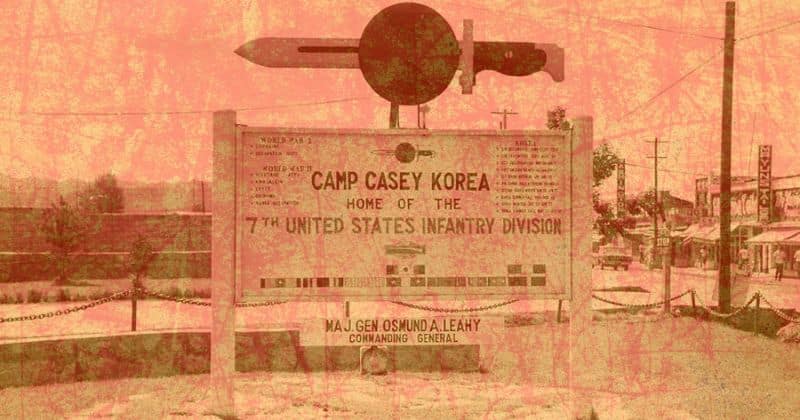
| Camp Casey (Dongducheon) | Main 2nd Infantry Division post, in the DMZ operational area | Headquarters for many recognized DMZ units; veteran statements and Board of Veterans’ Appeals decisions describe herbicide spraying on and around the base |
| Camp Hovey, Camp Howze, Camp Greaves and other DMZ-area camps | Forward camps along the DMZ corridor | Hosted 2nd and 7th Infantry Division units on the VA’s recognized list; service here can support a unit-based presumption claim, though the camps themselves are not separately listed as spray sites |
| Camp Carroll (Waegwan) | Far south of the DMZ | In 2011, U.S. veterans alleged that drums of “Compound Orange” had been buried here in 1978. A Republic of Korea and U.S. joint investigation found other contaminants but no definitive evidence of Agent Orange, so Camp Carroll is not a DMZ presumption site. |
| Camp Mercer (west of Seoul) | South of the DMZ | One of the sites sampled during the 2011 burial investigation; not part of the DMZ spraying presumption |
The VA often denies Korea cases because the veteran’s unit was not in or near the DMZ. While only the Korean DMZ corridor benefits from the presumption, any qualifying DMZ-area assignment during the covered window supports a claim.
On the other hand, veterans who state that the Agent Orange exposure happened at non-presumptive locations (such as Camp Carroll) must prove it themselves. It is a more difficult path that usually requires investigations and legal assistance.
Maximize Your Benefits
Unhappy with your VA decision? We’re here to help. Contact us for a free review of your case.
A Veteran’s Story on How He Won VA Disability Benefits
The testimony of veteran Charles Corn and how VA attorney Matthew Hill and the Hill & Ponton legal team succeeded in proving his exposure to Agent Orange in Korea:
Hill & Ponton has decades of experience winning VA compensation and back pay for veterans who were denied benefits for their Agent Orange and other toxin-related conditions. Get a free evaluation of your case today to see how we can help you.
Free case evaluationWhat Compensation Can Veterans Receive?
The VA disability compensation is based on the rating for the service-connected condition, plus retroactive back pay to the effective date of the claim. Monthly payments can be estimated using the VA Disability Calculator.
Service-connected conditions that prevent substantially gainful employment (a regular job that pays above poverty level) may qualify for Total Disability based on Individual Unemployability (TDIU), which is paid at the 100% rate.
Are Survivors of Korean DMZ Veterans Eligible for VA Benefits?
A surviving spouse, child, or in some cases a dependent parent may file a Dependency and Indemnity Compensation (DIC) claim if the veteran died from a service-connected condition, or from a condition that would have been service-connected if a VA disability claim had been filed and granted.
If the deceased veteran had previously filed an Agent Orange claim tied to Korean DMZ service that was wrongly denied, the surviving spouse may be entitled to back pay (based on an earlier effective date).
Hill & Ponton lawyers focus on winning appeals on behalf of veterans and surviving family members who were previously denied or underrated by the VA, with no upfront fees. Get a free case evaluation today!
Written by