
You didn’t have to handle asbestos to be exposed aboard a ship. But being aboard that ship and proving exposure to the VA are two different things. Decades later, service records may show which ship you served on without describing the conditions you lived and worked in. There are instances, somewhat rare, when records may say asbestos exposure, and that’s great. But if you don’t have that, it’s going to take a little bit more work.
If VA denied or underrated your claim for asbestos exposure aboard a ship or in a shipyard, my team may be able to help you. Get in touch for a free evaluation.
Free Case evaluationWhere Was Asbestos Used on Navy Ships?
Asbestos is an excellent thermal and electrical insulator, and it’s highly fire resistant, so it was used extensively in things like gaskets, insulation and fireproofing materials. Navy records place it aboard ships in thermal insulation and in the gaskets and packing used on boilers and piping.
The Naval Sea Systems Command’s FOIA reading room of asbestos-related files lists military specifications and qualified products lists (the Navy’s lists of products approved under a specification) that name asbestos outright, including:
- thermal insulation felt made of asbestos fiber (a 1962 qualified products list)
- spiral-wound metallic-asbestos gaskets for boilers (lists dated 1961 to 1974)
- high-pressure asbestos rod packing (1953 to 1968)
- compressed asbestos sheet gasket material (1971 to 1972)
- compressed asbestos sheet packing (1952 to 1981)
Asbestos could have been used almost everywhere on a ship. There’s no shortage of cases with insulated pipes passing through living spaces, and those have been recognized as an exposure route or an exposure pathway. So don’t forget time spent in locations such as sleeping quarters, storage rooms, mess halls, and common areas.
In an April 1, 2013 Board decision involving the destroyer U.S.S. Ault, the veteran described a pipe covered in asbestos over his bunk, and his brother, who had visited the ship, described the same poorly wrapped pipe and white powder on the veteran’s blanket. In a December 4, 2018 Board decision involving the attack transport U.S.S. Deuel (APA-160), the veteran described cleaning troop compartments with bunks and decks covered by asbestos that had fallen from the pipes.
When Did the Navy Stop Using Asbestos on Ships?
There’s no specific cutoff date when the Navy stopped using asbestos on ships. The phase out began in the 1970s, but the policy at that time was to leave it in until repairs required it to be removed or replaced. So it still could be present in ships for years or even decades later than the 70s.
Is There a VA List of Navy Ships with Asbestos?
There’s no official list of Navy ships that had asbestos or job duties that guarantee a finding of exposure (unlike some other exposures, there’s no presumption for asbestos). Veterans can find information about a ship in its logs and history. On the other hand, the Coast Guard has issued a list of cutters built before 1991 (when asbestos was still used) and in service from 1990 to 2017.
How Does VA Decide Asbestos Exposure from Ship Service?
VA decides shipboard exposure case by case, by weighing the veteran’s records and account against the circumstances of service. The steps in VA’s asbestos development procedures generally follow this order (although you can also submit evidence regarding exposure any time while the claim is pending):
1. Personnel records. VA obtains the veteran’s military personnel records, the file showing assignments, ships and dates (“the ship he was on,” in a family’s words), through a code O50 request to the National Personnel Records Center or through the Defense Personnel Records Information Retrieval System.
2. Development letter. VA sends a development letter, a request for more information, asking the veteran to describe where, when and how the exposure happened, and asking for medical evidence of the disease, such as a biopsy.
3. Weighing the evidence. VA considers occupational evidence, the answers to the letter, personnel records, service treatment records, and statements from family members, shipmates, and others who can vouch for the veteran, which VA calls buddy statements. It judges credibility and competency by plausibility, consistency with the rest of the record, and the source.
4. Examination. VA requests a medical examination even if the veteran never answers the development letter, and the examiner asks about the exposure history.
For Navy veterans, VA also checks the veteran’s rating (job) against a table that grades how likely each Navy job was to involve asbestos. A veteran who says “my job wasn’t in the engine room” is describing a job VA may rate as minimal probability. However, the job is only one consideration and VA decides each claim on its own merit.
What If My Job Isn’t on VA’s List?
A veteran whose job is not on VA’s Navy list can still prove asbestos exposure. VA considers:
- The veteran’s account and buddy statements about of the exposure
- Service personnel records showing duties and assignments
- Service treatment records
- All other evidence in the claims file
VA looks past the job title to the work the veteran actually performed. Did the veteran work in an engine or a boiler room? Around piping? On repair and renovation work that involved things like grinding and scraping and sanding and tearing?
Construction or demolition work counts the same way. One thing that’s often overlooked is cleaning or cleanup work after any of that other work happened. All of those could have been routes for exposure.
VA weighs this evidence for credibility, based on “plausibility, consistency with other evidence in the case, and source.” An account that names the ship or building, the dates, and the work performed, and that matches the personnel records, addresses each of those factors. Once exposure is shown and there is evidence of a current diagnosis or recurring symptoms, VA accepts lay testimony about symptoms as enough to request an examination and medical opinion.
Lay and buddy statements provide the color and the detail from a personal perspective, and they help fill in the gaps that the service records might leave. A statement such as “I slept under pipes wrapped in asbestos” is lay testimony (a non-expert’s account of what he saw and did), and the Regional Office and Board of Veterans’ Appeals can find it consistent with the place, type and circumstances of the veteran’s service.
This is an opportunity for you to tell your story. You can describe your duties, describe the living spaces and what the conditions were like. You can provide finer details, like how there were poorly wrapped pipes, with the insulation material swinging loosely or falling off of them.
You can talk about how, when you were performing the work that you were required to do, you didn’t have any personal protective equipment, so you were breathing in the dust and everything else that was floating in the air. Or you can talk about things like how, when you came back to your bunk, you would find that white powder had coated your blanket. It’s these little details that are going to help corroborate, help enhance your claim. Describe what you remember clearly and be honest about what you don’t.
Does a Shipyard Overhaul or Dry Dock Count as Exposure?
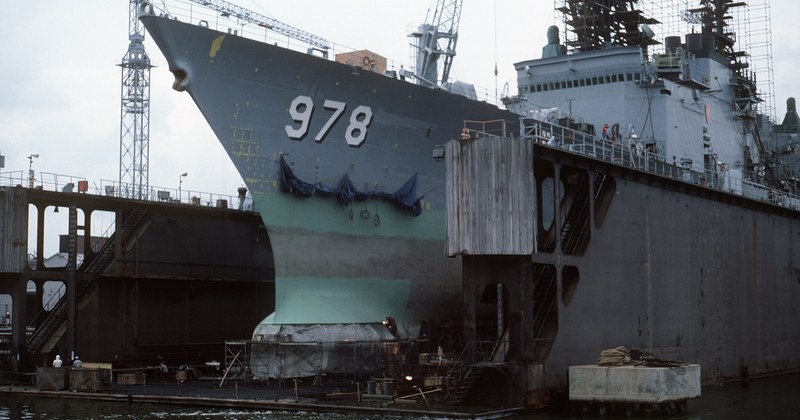
A shipyard period can establish asbestos exposure when the records show the veteran was aboard while the ship was in the yard, and the veteran’s account of the work or the living conditions is credible. Because insulation stayed aboard until repairs required it to come out, yard periods were a likely time for it to be torn out.
Exposure could have occurred both underway, but also while in a shipyard. When ships were in a dry dock period, they were often getting refitted or overhauled or repaired. And those are the exact types of work that disturb the asbestos material and cause it to shed and make the fibers airborne, which is what leads to the exposure.
Documenting “dry dock”, “refit” or any period of overhaul or repair means showing:
- The veteran was aboard. Personnel records give the dates of assignment.
- The ship was in the yard. Deck logs, a Command Operations Report or a DANFS entry can give the shipyard and the dates.
- What the veteran did or saw there. The veteran’s statement, statements from shipmates, and supporting items such as a cruise book describe the work, the torn-out insulation, or the berthing conditions.
Which Records Prove a Veteran Served on a Specific Ship?
Think of the evidence as a timeline. The personnel file proves assignment to a ship on specific dates, and the ship’s records prove where the ship was and what it was doing on those dates. These records can be not just the service file, but also things like deck logs, muster rolls, and command operation reports. A complete set usually comes from these sources, in this order:
1. Personnel records. Start with the DD-214 discharge form and the full personnel file. Veterans, and the next of kin of a deceased veteran, can request military service records from the National Archives online through eVetRecs or by mailing or faxing a Standard Form 180. For a file that may have been affected by the 1973 fire at the National Personnel Records Center, the National Archives asks for the place of discharge, last unit of assignment, and place of entry.
2. Deck logs. A deck log, what many veterans call “the ship’s log,” is the ship’s daily record of its movements and certain events, so it shows the ship in port, at sea, or in a shipyard on a given day. It does not usually prove that one sailor was aboard; the personnel file or muster roll does that.
3. Muster rolls. Muster rolls are the crew lists. After 1956, a list of officers is usually included with them.
4. Command Operations Reports. A Command Operations Report is a ship’s yearly chronology of significant events. The Naval History and Heritage Command (NHHC) suggests requesting it when a veteran does not know the exact dates needed for a deck log search.
5. DANFS. The Dictionary of American Naval Fighting Ships (DANFS) is the Navy’s published collection of ship histories. Entries often record overhauls by shipyard and date, and coverage varies by ship.
Navy ship histories can often provide the color and detail from an institutional perspective. They’ll tell what the ship was doing, when, and where. They can even sometimes show when the ship was being overhauled by a specific date and location, and if you can establish service at that date and location, you can help out your claim greatly.
| Record | What it shows | Where it is held | How to get it |
|---|---|---|---|
| Personnel file | The veteran’s assignments, ships and dates | National Archives (National Personnel Records Center) | eVetRecs or SF-180 (veteran or next of kin); VA requests it during the claim |
| Deck logs, 1941 to 1983 (unclassified; classified 1941 to 1978) | The ship’s daily movements and events | National Archives, College Park, Md. | Request from the National Archives |
| Deck logs, 1984 to present (unclassified; classified 1979 to present) | The ship’s daily movements and events | Naval History and Heritage Command | FOIA request with the ship’s name and specific dates; or request VA to obtain them |
| Muster rolls | Who was aboard | National Archives, College Park, Md. | Request from the National Archives |
| Command Operations Report | The ship’s year in summary | Naval History and Heritage Command | Request from the command |
| DANFS entry | The ship’s history, often with yard periods | Naval History and Heritage Command website | Free online |
Since July 29, 2021, VA’s Military Records Research Center has worked with the service branches to secure records and VA staff submit deck log requests through VA’s claims system. A veteran can therefore ask VA, in the claim, to obtain deck logs for named dates instead of filing a FOIA request (which takes months to be processed). The National Archives also reports that it partnered with VA to digitize Vietnam-era deck logs and is releasing them online in batches; logs not yet online still have to be requested.
One other type of evidence to also consider is medical records. These can be VA medical records or private medical records and basically from any time.
How Can Marines Prove Asbestos Exposure from Navy Ships?
It’s not just veterans from the Navy that were exposed to asbestos aboard Navy ships. So don’t just automatically think, I wasn’t in the Navy, so this doesn’t apply to me. Marines and veterans from other branches can prove asbestos exposure through personnel records showing the ships and dates, combined with evidence of where they lived and worked aboard.
1. VA’s other-branch rule. A Marine who held one of the occupations in VA’s Navy job table gets the same conceded probability as a sailor in that job. Every other Marine proves exposure through occupational evidence, lay testimony, personnel records, service treatment records and buddy statements.
2. The passage records. Personnel records can show each transport and the dates aboard. NHHC keeps no deck logs for Army transports, merchant ships, or Military Sea Transportation Service and Military Sealift Command ships, and the National Archives describes Navy deck logs as records of commissioned Navy ships. For a Marine transported on one of those other vessels, the personnel record’s transport entries may be the main proof of the passage.
3. The troop spaces. Statements about the troop compartments and berthing, from the Marine or from others aboard, show how close the Marine lived to the ship’s insulation.
Other Requirements for an Asbestos Claim from Ship Service
Exposure to asbestos is just the first component or the first part of any claim. You also are still going to have to have a current disability and a nexus establishing a relationship to service. VA’s procedures require medical evidence of the specific diagnosis in every asbestos claim.
That nexus component is oftentimes going to be the most difficult part. Latency periods for conditions to develop can be decades, and sometimes with the conditions, the available medical and scientific evidence might not be well known or understood. A strong nexus letter, the medical opinion connecting the disease to service, can come from personal doctors, from a C&P examination, or from a medical opinion obtained independently (similar to what VA does with C&P contractors).
A lot of times there might be other risk factors for some of these conditions, things like smoking or civilian asbestos work. Just because you may have engaged in other risk factors, that’s not an automatic denial. It means the nexus opinion should:
- address the ship and the dates of service
- fully consider those other factors
- consider the full extent of available medical evidence and scientific literature
- acknowledge and recognize that latency periods can be delayed
Even if the claim is denied, veterans (or their survivors) can request a Higher-Level Review, file a Supplemental Claim with new and relevant evidence, or appeal to the Board of Veterans’ Appeals. Deck logs, muster rolls or a shipmate’s statement found after the denial can be that new evidence.
Has VA Denied Your Exposure or the Link to Military Service?
Hill & Ponton has assisted veterans since 1986, with a success rate of 96% for the cases we take on. Our VA-accredited attorneys have decades of experience winning toxic exposure appeals for veterans and their survivors, with no upfront costs and no fee unless we win. Request a free case evaluation to see if we can help with your claim.
Written By

Derek Scadden
Attorney, Hill & Ponton, P.A.
With over a decade of experience in veterans benefits law, Derek Scadden is an attorney dedicated to public service, appellate advocacy, and advancing veterans' access to the benefits they have earned. Prior to joining Hill & Ponton, Derek spent ten years at the Department of Veterans Affairs, Office of General Counsel, including serving as the Deputy Chief Counsel and Acting Chief Counsel of the Benefits Law Group, where he was responsible for providing legal guidance to VA on all aspects of VA benefts.