
This Article covers:
Click a title to scroll down to that section
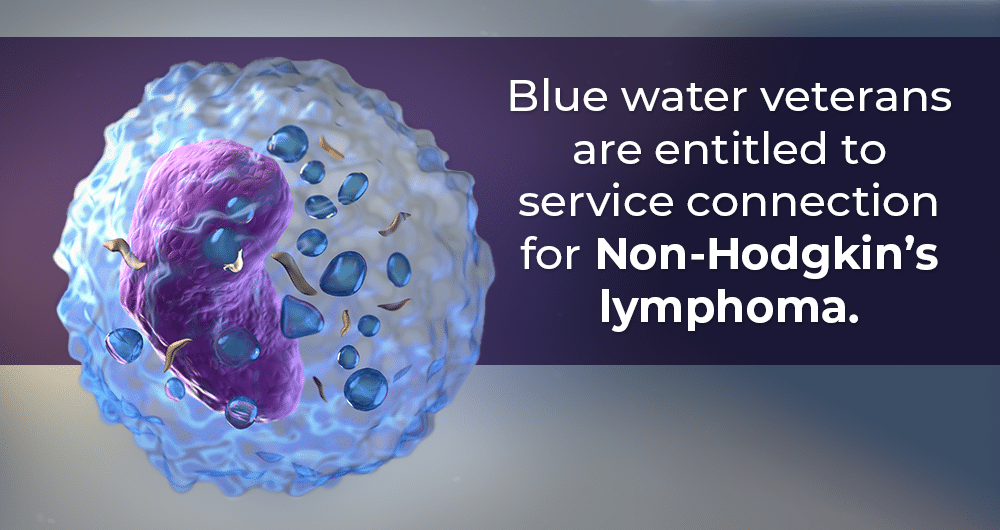
Non-Hodgkin’s lymphoma is a presumptive Agent Orange condition, so a Vietnam War veteran seeking disability benefits usually needs only evidence of qualifying herbicide exposure and a confirmed diagnosis that meets VA’s compensable disability requirements. Veterans denied in the past can file again, and eligible survivors of a veteran who died of non-Hodgkin’s lymphoma can also qualify for benefits.
What Is the VA Agent Orange Presumption for Non-Hodgkin’s Lymphoma?
For veterans who served in a location where VA recognizes Agent Orange exposure, the VA presumes both the exposure and the medical link between it and non-Hodgkin’s lymphoma, according to 38 CFR 3.309(e).
What does it take to benefit from the presumption? Establish qualifying service or actual qualifying herbicide exposure and provide medical evidence confirming non-Hodgkin’s lymphoma at a compensable level. A past diagnosis, remission, or compensable residuals can still satisfy the disability requirement depending on the veteran’s record.
The VA presumption is based on decades of research into dioxin (TCDD), the contaminant in Agent Orange. The National Academies’ Veterans and Agent Orange reviews placed non-Hodgkin’s lymphoma among the conditions with sufficient evidence of an association with herbicide exposure.
How Does Agent Orange Increase the Risk of Non-Hodgkin’s Lymphoma?
A population-based, case-control study of non-Hodgkin’s lymphoma between 1984 and 1988 revealed an approximately 50% higher risk among Vietnam veterans compared to those who hadn’t served in Vietnam (Selected Cancers Cooperative Study Group, Arch Intern Med, 1990).
The Selected Cancers Cooperative Study Group examined several cancer outcomes present in Vietnam veterans, including lymphoma (both Hodgkin’s and non-Hodgkin’s), sarcoma, nasal cancer, nasopharyngeal cancer, and primary liver cancer.
While previous research had focused on the association between cancer and exposure to herbicides, it produced inconsistent results, because no indirect method, military record, or self-reported exposure could reliably distinguish exposed from unexposed veterans. So, instead, the CDC focused on the association between the cancers and Vietnam service.
The researchers found a roughly 50% increased risk for non-Hodgkin’s lymphoma in Vietnam veterans, yet the risk of contracting it was not related to the known patterns of spraying Agent Orange in Vietnam: there was little difference by dates of service, type of unit, military region, or other characteristics that might have been associated with Agent Orange use.
In fact, the highest risk of contracting non-Hodgkin’s lymphoma appeared to be among Navy veterans who were stationed on ships off the coasts of Vietnam. While it was only a suggestive finding, it could be inferred that the lack of direct exposure to Agent Orange does not necessarily rule out a veteran’s likelihood of contracting cancer.
Research on the health effects of Agent Orange led to a 1990 VA regulation stating that Vietnam service plus a diagnosis of non-Hodgkin’s lymphoma was enough to establish service connection, followed by the Agent Orange Act of 1991. 35 years later, the VA presumption has been expanded, and science continues to confirm the high risk of non-Hodgkin’s lymphoma in Vietnam era veterans.
A 2025 study (Polygenic Risk, Agent Orange Exposure, and Lymphoid Neoplasms in the Veterans Affairs Million Veteran Program) found that Agent Orange exposure was associated with an increased risk of lymphatic cancers, including a 61% increased risk for chronic lymphocytic leukemia, a 71% increased risk for follicular lymphoma, and a 26% increased risk for diffuse large B-cell lymphoma.
Which Veterans with NHL Qualify for Benefits Through Agent Orange Exposure?
Thanks to laws like the Blue Water Navy Vietnam Veterans Act of 2019 and the PACT Act of 2022, the VA presumption now reaches well beyond service in Vietnam. Qualifying locations and dates include:
- Republic of Vietnam: January 9, 1962 to May 7, 1975 (including inland waterways, blue water Navy, and coastal operations)
- Korean DMZ: September 1, 1967 to August 31, 1971
- Thailand military bases: January 9, 1962 to June 30, 1976
- Laos: December 1, 1965 to September 30, 1969
- Cambodia at Krek Mimot or Kampong Cham Province: April 16 to April 30, 1969
- Johnston Atoll: January 1, 1972 to September 30, 1977
- Guam or American Samoa: January 9, 1962 to July 31, 1980
- Regular and repeated operation, maintenance, or service aboard C-123 aircraft formerly used to spray Agent Orange or herbicides
The Blue Water Navy ship locator helps offshore Navy veterans confirm qualifying service.
Veterans with a non-Hodgkin’s lymphoma diagnosis who served outside a presumptive location must prove that they were actually exposed to a qualifying herbicide agent, but once the exposure is established, the presumption applies to them too.
What If VA Denies the Connection to Agent Orange?
Veterans should gather service records that place them in a recognized exposure setting along with oncology and pathology records. Even though the condition is presumptive, claims are still denied, most often because VA is not satisfied that qualifying exposure occurred or because the diagnosis in the record is unclear. Addressing those two points before filing can prevent common delays and denials.
When the VA denies a claim, a veteran has three review options: a Supplemental Claim with new and relevant evidence, a Higher-Level Review by a senior adjudicator, or an appeal to the Board of Veterans’ Appeals (BVA). An accredited VA attorney with experience in Agent Orange claims can help assemble the exposure record and represent the veteran through an appeal.
BVA Decisions on Agent Orange Non-Hodgkin’s Lymphoma Claims
Because NHL is a presumptive condition for Veterans exposed to herbicides, claims that show both a confirmed diagnosis and confirmed herbicide exposure will be granted. The smaller number of cases that go before the Board of Veterans’ Appeals tend to involve disputed exposure histories or unclear diagnoses.
Hill & Ponton analyzed the Board of Veterans’ Appeals decisions from 2021 through 2025 in which non-Hodgkin’s lymphoma was specifically claimed in connection with Agent Orange or herbicide exposure. 15 of the 31 instances identified were approvals (48.4%), 10 were denials (32.3%), and 6 were remands (19.4%). These NHL decisions at the BVA level indicate that veterans with complicated cases who were previously denied can still succeed when they provide the right evidence.
How Does the VA Rate Non-Hodgkin’s Lymphoma?
Under Diagnostic Code 7715 in 38 CFR 4.117, VA assigns a 100 percent rating when non-Hodgkin’s lymphoma is active, during a treatment phase, or during an indolent and non-contiguous phase of low-grade lymphoma. The 100 percent rating continues for two years after treatment ends.
VA then conducts a mandatory examination. If the lymphoma has not returned after treatment, VA rates the remaining residuals (including lasting effects of chemotherapy or radiation and effects on other organ systems) under the diagnostic codes that best match each residual. The evaluation depends on the diagnosed condition, its severity, and how it affects the veteran.
Rating the Residuals of Non-Hodgkin’s Lymphoma
- Lymphedema: a residual effect of lymphoma characterized by chronic swelling due to damage or removal of lymph nodes. Long-term, severe lymphedema could be rated at 10% to 100% under various diagnostic codes, depending on the affected body part, the severity of swelling and pain, and the extent to which it limits movement or daily function.
- Enlarged lymph nodes: residual or non-cancerous lymphadenopathy has no dedicated diagnostic code and is rated by analogy to the condition it most resembles, so the percentage depends on the specific functional impairment. Enlarged lymph nodes alone do not automatically prove that the lymphoma has returned; recurrence must be confirmed by medical evidence.
- Lymphadenectomy (lymph node removal): rated under scarring or disfigurement from 0% to 80% based on location, pain, size, and any negative cosmetic effects.
- Anemia: rated at 0% to 100% depending on the type, laboratory findings, need for treatment, and overall health effects.
- Chronic fatigue syndrome: rated between 10% and 100% if separately diagnosed or appropriately rated by analogy. Ordinary treatment-related fatigue does not automatically qualify as chronic fatigue syndrome.
- Peripheral neuropathy: rated at 10% to 40% or higher per affected limb, based on nerve impairment.
- Organ damage or dysfunction: rated between 0% to 100%, depending on which organ is involved and the impairment level.
How Much Does NHL VA Disability Pay?
The 2026 tax-free compensation for the 100% rating starts at $3,938.58 per month for a single veteran with no dependents. The VA disability calculator estimates compensation based on rating and family situation and calculates the combined rating for multiple disabilities. Other benefits are also available.
2026 VA Disability Calculator
Quickly calculate your combined VA disability rating and see the compensation you should receive.
Learn MoreWhat Survivor Benefits Can Families Receive?
When a veteran dies from service-connected non-Hodgkin’s lymphoma, an eligible surviving spouse, dependent child, or dependent parent can qualify for Dependency and Indemnity Compensation (DIC).
Each survivor category has separate eligibility rules, and dependent parents are subject to income limits. Survivors can file even if the veteran never had a claim granted during life, as long as the evidence (including the death certificate and medical records) shows that NHL caused or materially contributed to death and was connected to qualifying service.
Some veterans and survivors can get an effective date (the date VA uses to decide when benefits begin) tied to an earlier claim or denial. The exact date depends on when VA received the earlier claim, when the disease arose, and the Nehmer rules for effective dates. It does not automatically reach the date of diagnosis or the veteran’s service, but back pay can be substantial.
Hill & Ponton has successfully represented thousands of veterans and survivors nationwide in Agent Orange-related appeals. If you were denied or underrated on a non-Hodgkin’s lymphoma claim, request a free case evaluation: we’ll give you an honest opinion and charge nothing unless we take the case and win your compensation.
Content Reviewed by
Attorney Stacey Clark

Attorney Stacey Clark is a native Floridian and has represented veterans before the VA, BVA, CAVC, and other federal courts with over 10 years of hands-on experience. She is the only attorney practicing veterans law who has been recognized as a Florida Rising Star by Florida Super Lawyer Magazine; an award that only 2.5% of Florida attorneys have received.
Written by