
Camp Santiago
Mariano Colón, Salinas
 Known Toxins
2
 Years of Operation
1940-Present
Base Background
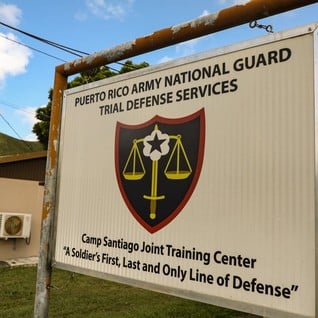
Camp Santiago Joint Training Center is a Puerto Rico Army National Guard installation in Salinas, on Puerto Rico’s south coast about 51 miles from San Juan. The U.S. Army acquired the land from the Commonwealth of Puerto Rico in 1940 and ran it as the Salinas Training Area before licensing it to the Puerto Rico National Guard in 1967. The camp was renamed in 1975 for Specialist Four Héctor Santiago-Colón, a Salinas-born Medal of Honor recipient killed in Vietnam. Today the roughly 16,000-acre installation remains active as the primary annual training site for the Puerto Rico Army National Guard, Army Reserve, Marine Corps Reserve, and Air National Guard, hosting summer field training exercises and monthly weekend drills. Camp Santiago has no permanent residents: guardsmen and reservists rotate through for training rather than living on post.
Toxic Exposure at Camp Santiago
Camp Santiago’s decades of firefighting training and small-arms range use have left a documented environmental record with EPA. Guardsmen, reservists, and civilian staff who trained or worked in these areas over the years may have been exposed to PFAS and lead.
PFAS Contamination
Firefighting crews at Camp Santiago used aqueous film-forming foam (AFFF) containing per- and polyfluoroalkyl substances (PFAS) for decades during training exercises, the same foam behind PFAS investigations at hundreds of other installations across the country. The Puerto Rico Army National Guard’s own environmental records confirm that Camp Santiago has completed both a Preliminary Assessment and a follow-up Site Inspection, the initial screening steps the Department of Defense uses to decide whether a site needs to move into a more detailed remedial investigation.
Lead Contamination
Camp Santiago’s firing ranges have reported lead to the EPA’s Toxics Release Inventory every year since 2007, all of it classified as on-site land disposal rather than an air or water release, consistent with spent ammunition accumulating in range soil and berms over decades of small-arms training. Reported totals have ranged from roughly 3,600 to 8,100 pounds a year, including 4,733 pounds in 2007, 8,098 pounds in 2010, and 5,711 pounds in the most recent 2024 report.
Guardsmen and reservists who served as range instructors or cadre, ran weapons qualification, or handled range maintenance and berm cleanup faced the most direct and repeated exposure, since those duties put them in hands-on contact with lead dust and residue in the range soil itself.
Getting Compensation
Personnel who trained or worked at Camp Santiago over the decades could have been exposed to these substances without any warning at the time, and the cancers associated with it can take decades years to surface. Check the chart below for the health conditions this exposure has been tied to.
Those who trained at Camp Santiago, and their surviving family members, may qualify for compensation and other veterans benefits in Puerto Rico or their state of residence: Hill & Ponton’s handle these claims on contingency, so there’s never a fee unless we win. Start with a to find out where you stand.
Known Toxins
The following chart outlines the medical conditions associated with toxic exposure at this base, classified by the strength of evidence required (strong, good or limited).* Please keep in mind that it is not a complete list.
| Toxin | Potential Effects & Strength of Evidence Needed | |||
|---|---|---|---|---|
| Strong | Good | Limited | ||
| Lead | Potential Effects & Strength of Evidence Needed | Seizures Reduced Fertility Male (infertility and subfertility)... Peripheral neuropathy Hypertension Gout Developmental Delay Decreased I.Q../Mental retardation Decreased Coordination/ Dysequilibrium Coronary artery disease, peripheral vascular disease, atherosclerosis Cognitive impairment (includes impaired learning, impaired memory, and decreased attention span) Chronic renal disease Behavioral problems Anemia hemolytic ADD/ADHD, hyperactivity Abnormal sperm (morphology, motility, and sperm count) |
Reduced Fertility Female (infertility and subfertility) Psychiatric disturbances... Preterm delivery Porphyria toxic Pancreatic cancer Nephrotic syndrome Low birth weight/Small for Gestational Age Immune suppression Hearing loss Glomerulonephritis Fetotoxicity (Miscarriage/spontaneous abortion; stillbirth) Delayed growth Cardiomyopathy Arrhythmias Altered time to sexual maturation (accelerated or delayed puberty) |
Wilm's Tumor Uterine cancer... Thyroid disorders Hypothyroidism Stomach cancer Reduced Fertility Male (infertility and subfertility) Osteoporosis Neurosthenia (Organic affective syndrome) Lung cancer Hepatocellular cancer (Liver cancer) Erectile dysfunction Diabetes Type II Congenital malformation Cranio Facial Colorectal cancer Carcinoid Breast cancer Brain cancer adult Bladder cancer Alzheimer's Altered time to sexual maturation (accelerated or delayed puberty) ALS (Lou Gehrig's disease) Abnormal sperm (morphology, motility, and sperm count) |
| PFAS (Firefighting Foam) | Potential Effects & Strength of Evidence Needed | - | - | Testicular cancer Renal (kidney) cancer... Prostate cancer |
How to Build a VA Disability Claim
- Document the time spent at the base using service records and other documentation
- Gather comprehensive medical evidence
- Obtain expert medical opinions to establish a link between the diagnosed medical conditions and the toxic exposure