
Fort Buchanan
Guaynabo, Guaynabo
 Known Toxins
1
 Years of Operation
1923-Present
Base Background
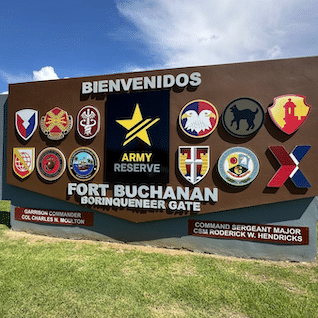
Fort Buchanan began in 1923 as Camp Buchanan, a roughly 300-acre training area on the south shore of San Juan Bay for the Army’s Puerto Rico Regiment. The Army redesignated it Fort Buchanan in May 1940, naming it for Brigadier General James A. Buchanan, the regiment’s first commander, and expanded the post to 4,500 acres to serve as a World War II supply depot and troop-processing center. The installation sits today on 756 acres in Guaynabo, Puerto Rico, as a U.S. Army Garrison hosting the 1st Mission Support Command, other Army Reserve and Puerto Rico National Guard components, and Navy and Marine Corps Reserve units, supporting a population the garrison itself puts at roughly 130,000 veterans, retirees, military personnel, and dependents across Puerto Rico, the U.S. Virgin Islands, and Latin America.
Toxic Exposure at Fort Buchanan
Fort Buchanan is one of hundreds of Department of Defense installations nationwide under review for contamination tied to aqueous film-forming foam (AFFF), a firefighting foam containing per- and polyfluoroalkyl substances (PFAS), including perfluorooctanoic acid (PFOA) and perfluorooctane sulfonate (PFOS). The Army finished a site-specific PFAS study here in March 2022, and its engineers are now mapping how far the contamination has traveled underground, with that phase targeted to wrap up by September 2035.
The Army reports that its own drinking water system on base currently meets the EPA’s 2024 federal drinking water standards, which cap PFOA and PFOS at 4 parts per trillion each. For private wells near the installation, Department of Defense policy calls for interim measures, such as bottled water, filtration, or a municipal water connection, once PFOS or PFOA levels reach 12 parts per trillion, three times the EPA’s enforceable limit.
Getting Compensation
Fire crews and personnel who spent time around Fort Buchanan’s flight line and training areas during the decades AFFF saw regular use had no way of knowing PFAS was in the mix, and conditions tied to that kind of exposure can stay hidden for years before a diagnosis explains them. A service member who trained or worked at Fort Buchanan and was later diagnosed with one of these conditions can still bring a claim now.
The chart below lists the conditions tied to PFAS contamination. Hill & Ponton’s VA-accredited lawyers have decades of experience winning toxic exposure claims for veterans and their survivors alike. Get in touch for a free evaluation: we focus exclusively on VA disability appeals and work on a contingency basis, with no upfront fees.
Known Toxins
The following chart outlines the medical conditions associated with toxic exposure at this base, classified by the strength of evidence required (strong, good or limited).* Please keep in mind that it is not a complete list.
| Toxin | Potential Effects & Strength of Evidence Needed | |||
|---|---|---|---|---|
| Strong | Good | Limited | ||
| PFAS (Firefighting Foam) | Potential Effects & Strength of Evidence Needed | - | - | Testicular cancer Renal (kidney) cancer... Prostate cancer |
*Effects are according to the Center for Disease Control and Prevention’s Agency for Toxic Substances & Disease Registry unless otherwise noted.
A diagnosis linked to toxic exposure at Fort Buchanan can support a VA disability claim, but proving it means building a record: service documentation placing you at the installation, medical records establishing the condition, and a medical opinion tying the two together.
To win your case, you may need assistance interpreting complex medical and scientific evidence, addressing VA denials and ensuring all deadlines are met. Hill & Ponton’s VA-accredited lawyers can fight on your behalf to maximize compensation and other veteran benefits in Puerto Rico or wherever you now live. Reach out for a free case evaluation to get started.