
Richards-Gebaur Air Force Base
Kansas City, MO
 Known Toxins
6
 Years of Operation
1941-1994
Base Background
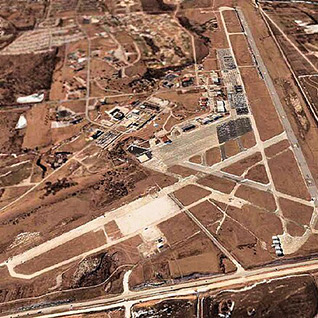
Kansas City built Grandview Airport in 1941, and during World War II the Army Air Forces used part of the field as an overflow training sub-base for nearby Sedalia Army Air Field (now Whiteman Air Force Base), while the Navy used it as an outlying landing field for pilots training at NAS Olathe, Kansas. The Air Force leased the airport in 1952 and opened it as Grandview Air Force Base that October, then renamed it Richards-Gebaur Air Force Base in April 1957, honoring Kansas City-born aviators 1st Lt. John Francisco Richards II and Lt. Col. Arthur William Gebaur Jr.
For more than a decade, Air Defense Command fighter-interceptor squadrons flew F-86D, F-102, and F-106 aircraft from the base, and an Air Force Reserve wing was stationed there for decades afterward. The military mission ended under a Base Realignment and Closure decision effective September 30, 1994; most of the land transferred to Kansas City, and Port KC later redeveloped much of the former base as an industrial park known as 49 Crossing, though an Army Reserve presence remains on part of the site today.
Toxic Exposure at Richards-Gebaur AFB
Decades of aircraft operations, fuel storage, and firefighting training left contamination in the base’s soil and groundwater that the Air Force still manages today, even though the site was never placed on the National Priorities List.
PFAS Contamination
Firefighting foam containing PFAS was used in a training area built around a mockup airplane to practice suppressing aircraft fires. The Air Force began assessing PFAS at Richards-Gebaur in 2015, and DoD’s June 30, 2026 progress report shows the site past its initial screening and into a full remedial investigation, with an estimated wrap-up of September 2035.
Volatile Organic Compounds
EPA’s own contaminant records for the site list 1,1-dichloroethene, vinyl chloride, tetrachloroethylene (PCE), trichloroethylene (TCE), and cis-1,2-dichloroethene in groundwater, along with total petroleum hydrocarbons in soil. Cleanup crews have spent years tracking a handful of small, persistent TCE plumes, including one that took more than a decade to trace to an old communications building before the structure was removed. A separate project excavated a former fuel tank yard and firing range.
Getting Compensation
Airmen stationed at Richards-Gebaur through the 1950s, 60s, and 70s had no reason to think twice about the buildings they worked in or the runoff near the flight line, and the resulting diseases can take decades to show up. The base closed more than 30 years ago, but a veteran diagnosed more recently, or an eligible survivor filing on their behalf, could still qualify for compensation.
The chart below lists the health conditions tied to the substances documented at Richards-Gebaur. Our VA-accredited lawyers focus solely on VA disability law and have built a track record handling toxic exposure claims for veterans and their families. A free case evaluation costs nothing, and since we work on contingency, you won’t owe us anything unless your claim succeeds.
Known Toxins
The following chart outlines the medical conditions associated with toxic exposure at this base, classified by the strength of evidence required (strong, good or limited).* Please keep in mind that it is not a complete list.
| Toxin | Potential Effects & Strength of Evidence Needed | |||
|---|---|---|---|---|
| Strong | Good | Limited | ||
| 1,2-dichloroethylene | Potential Effects & Strength of Evidence Needed | - | - | - |
| PFAS (Firefighting Foam) | Potential Effects & Strength of Evidence Needed | - | - | Testicular cancer Renal (kidney) cancer... Prostate cancer |
| Tetrachloroethylene | Potential Effects & Strength of Evidence Needed | - | Reduced Fertility Female (infertility and subfertility) Reduced Fertility Male (infertility and subfertility)... Pulmonary edema Menstrual disorders Lymphoma non Hodgkin's Fetotoxicity (Miscarriage/spontaneous abortion; stillbirth) Esophageal cancer Arrhythmias |
Scleroderma Renal (kidney) cancer... Raynaud's phenomenon Peripheral neuropathy Pancreatic cancer Lung cancer Low birth weight/Small for Gestational Age Hepatocellular cancer (Liver cancer) Congenital malformation Cranio Facial Color vision disturbance Cognitive impairment (includes impaired learning, impaired memory, and decreased attention span) Cervical cancer Breast cancer Bladder cancer Adult-Onset Leukemias Acute tubular necrosis |
| Total Petroleum Hydrocarbons (TPE) | Potential Effects & Strength of Evidence Needed | - | - | - |
| Trichloroethylene (TCE) | Potential Effects & Strength of Evidence Needed | Acute hepatocellular injury (Hepatitis) |
Scleroderma Renal (kidney) cancer... Psychiatric disturbances Lymphoma non Hodgkin's Hepatocellular cancer (Liver cancer) Fetotoxicity (Miscarriage/spontaneous abortion; stillbirth) Decreased Coordination/ Dysequilibrium Cirrhosis Childhood Leukemias Cardiac congenital malformations Autoimmune antibodies, positive ANA Arrhythmias |
Trigeminal neuropathy Testicular cancer... Systemic Lupus Erythematosus Raynaud's phenomenon Prostate cancer Peripheral neuropathy Pancreatitis Pancreatic cancer Oral clefts (cleft lip and palate) Neural tube defects/CNS malformations Nephrotic syndrome Multiple myeloma Lung cancer Low birth weight/Small for Gestational Age Immune suppression Hodgkin's Disease (lymphoma) Genitourinary malformations (includes cryptorchidism, hypospadias) Cognitive impairment (includes impaired learning, impaired memory, and decreased attention span) Choanal atresia Cervical cancer Brain cancer adult Adult-Onset Leukemias ADD/ADHD, hyperactivity Acute tubular necrosis |
| Vinyl chloride | Potential Effects & Strength of Evidence Needed | Vinyl chloride disease - Acroosteolysis Raynaud's phenomenon |
Thrombocytopenia Scleroderma... Pulmonary fibrosis Porphyria toxic Hepatoportal Sclerosis Hepatocellular cancer (Liver cancer) |
Skin cancer (nonmelanoma) Renal (kidney) cancer... Pancreatic cancer Neural tube defects/CNS malformations Lung cancer Laryngeal cancer Immune suppression Hypertension Erectile dysfunction Breast cancer Brain cancer adult Autoimmune antibodies, positive ANA |
*Effects are according to the Center for Disease Control and Prevention’s Agency for Toxic Substances & Disease Registry unless otherwise noted.
If you developed a medical condition related to toxic exposure after living or working at or near Richards-Gebaur Air Force Base, our VA disability lawyers may be able to help you obtain compensation and veterans benefits in Missouri or your state of residence. Get a free case evaluation to explore your legal options.