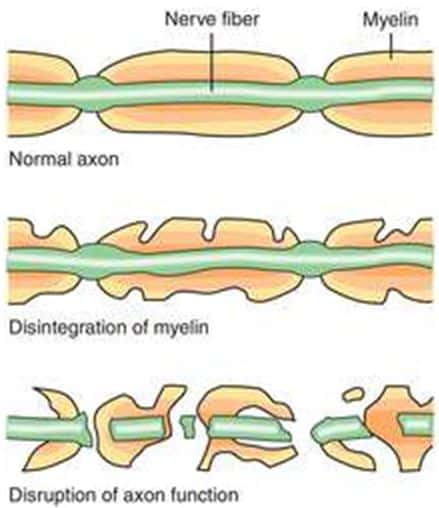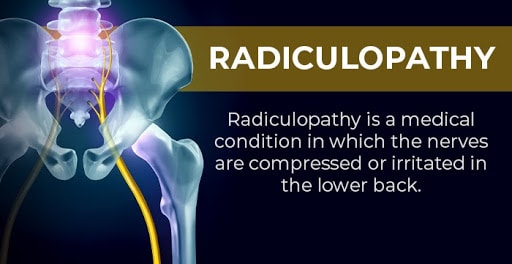

Radiculopathy that radiates from a service-connected lumbar spine condition is often overlooked or underrated. But under VA regulations the nerve symptoms caused by a lumbar spine condition must be rated separately, which could make a big difference in monthly disability payments.
This guide explains how the VA rates radiculopathy of the lower extremities, how to prove secondary service connection from a lower back disability, and the evidence that consistently moves the needle from a 10% rating to a 20%, 40%, or even higher rating (and the benefits that come with it).
Linking Radiculopathy to Lower Back Pain
The lumbar spine carries the weight of the upper body and absorbs the impact of every step, lift, jump, or parachute landing. Radiculopathy is what happens when a spinal nerve root is pinched, compressed, or irritated as it exits the spine.
Veterans most often describe lumbar radiculopathy as sciatica, but that is a lay term. The medical labels you will see on imaging reports, EMG studies, and C&P exam reports include lumbar radiculopathy, lumbosacral radiculopathy, sciatic neuropathy, sciatic nerve impingement, femoral neuropathy, and nerve root irritation at L4, L5, or S1.
Under VA law, the label matters less than the pattern of symptoms and the nerve involved. Sciatic nerve symptoms typically run down the back of the thigh into the calf and foot. Femoral nerve symptoms run into the front of the thigh and the inner knee.
Common Radiculopathy Symptoms in Veterans
- Shooting or burning pain that starts in the lower back or buttock and travels down one or both legs
- Numbness or pins-and-needles in the thigh, calf, foot, or specific toes
- Weakness in the leg, foot, or ankle, often noticed when climbing stairs or pushing off the foot
- Foot drop, where the front of the foot cannot lift fully and the toes catch on the ground
- Reduced or absent reflexes at the knee or ankle
- Loss of sensation in a defined patch of the leg or foot (a dermatomal pattern)
- Falls, stumbling, or an antalgic gait that favors one leg
- Pain that worsens with sitting, bending, coughing, sneezing, or prolonged standing
- In severe cases, bowel, bladder, or erectile dysfunction symptoms (new or worsening bowel or bladder dysfunction, saddle anesthesia, or rapidly progressive leg weakness can indicate a medical emergency and should be evaluated immediately)
How the VA Rates Lower-Extremity Radiculopathy
The VA rates radiculopathy of the legs under the peripheral nerve diagnostic codes in 38 CFR 4.124a, separately from the rating assigned to the lower back itself (which covers limitation of motion, pain on movement, muscle spasm, and spine mechanics).
Each affected leg gets its own radiculopathy disability rating; VA then combines them using its combined ratings table. You can calculate the rating and estimate your monthly compensation using the VA disability calculator.

Sciatic Nerve (Diagnostic Code 8520)
The sciatic nerve is the largest nerve in the body and the one most often affected by lumbar disc disease, stenosis, and radiculopathy at L4-L5 and L5-S1. Symptoms run down the back of the thigh, the calf, and into the foot. This is the code that most veterans with lumbar radiculopathy are rated under. Find out more about sciatic nerve VA ratings.
| Rating | Criteria |
|---|---|
| 80% | Complete paralysis of the sciatic nerve. The foot dangles and drops, no active movement is possible of muscles below the knee, and flexion of the knee is weakened or (very rarely) lost. |
| 60% | Severe incomplete paralysis with marked muscular atrophy. |
| 40% | Moderately severe incomplete paralysis. |
| 20% | Moderate incomplete paralysis. |
| 10% | Mild incomplete paralysis. |
Femoral Nerve (Diagnostic Code 8526)
The femoral nerve runs into the front of the thigh. Veterans with higher lumbar disc disease (L2-L3, L3-L4) or upper-lumbar nerve root compression often have femoral nerve symptoms instead of, or in addition to, sciatic nerve symptoms. Common findings include weakness of the quadriceps muscles and reduced knee-jerk reflex.
| Rating | Criteria |
|---|---|
| 40% | Complete paralysis of the anterior crural (femoral) nerve. Paralysis of the quadriceps extensor muscles. |
| 30% | Severe incomplete paralysis. |
| 20% | Moderate incomplete paralysis. |
| 10% | Mild incomplete paralysis. |
Other Lower-Extremity Nerves
When radiculopathy primarily involves a more distal nerve, a different code applies. Alternatives include DC 8521 for the external popliteal (common peroneal) nerve, which is a common diagnostic code for foot drop, and DC 8525 for the posterior tibial nerve, which can produce calf weakness and altered foot sensation.
| Diagnostic Code | Rating Range |
|---|---|
| DC 8521 (external popliteal / common peroneal) | 10%, 20%, 30%, 40% (mild, moderate, severe, complete) |
| DC 8525 (posterior tibial) | 10%, 10%, 20%, 30% (mild, moderate, severe, complete) |
| DC 8527 (internal saphenous) | 0%, 10% (mild or moderate, severe to complete) |
| DC 8530 (ilio-inguinal) | 0%, 10% (mild or moderate, severe to complete) |
How the VA Decides Mild, Moderate, Moderately Severe, and Severe
The CFR does not give a precise definition of each severity level. Instead, VA is required to consider the actual extent of motor, sensory, and reflex impairment. Two important rules drive most rating decisions:
- Wholly sensory symptoms (pain, tingling, numbness without measurable weakness or reflex loss) should be rated as mild, or at most, moderate.
- When motor weakness, reflex changes, muscle atrophy, or measurable functional impairment is documented, the rating should rise to moderate, moderately severe, or severe depending on the extent.
Many veterans get underrated at 10% when the record actually supports 20% or more. Evidence that can support a higher rating includes documented weakness, abnormal reflexes, muscle atrophy, reduced sensation, falls, foot drop, use of cane/bracing, antalgic gait, severe radiating pain, and functional limits with walking, standing, stairs, or driving.
Do not ignore bowel, bladder or erectile dysfunction either. Those can affect separate ratings or indicate more serious neurologic involvement. An experienced VA attorney can help you win all the benefits you’re entitled to receive (see what other veterans have to say).
Maximize Your Benefits
Unhappy with your VA decision? We’re here to help. Contact us for a free review of your case.
Proving Service Connection
If the lower back pain is already recognized and service connected, radiculopathy of one or both legs is claimed as a secondary disability. The legal standard is that the radiculopathy must be proximately due to, the result of, or aggravated by, the service-connected lumbar spine condition.
This pathway applies when the veteran already has a service-connected back condition such as lumbar strain, degenerative disc disease, lumbar disc herniation, intervertebral disc syndrome (IVDS), spondylosis, spondylolisthesis, spinal stenosis, or lumbar arthritis. The required elements are:
- A current diagnosis or documented symptoms of radiculopathy
- A service-connected spine condition
- A medical nexus opinion linking the two using the VA’s standard of proof (“at least as likely as not”)
Example: “It is at least as likely as not that the Veteran’s right (or left) lower-extremity radiculopathy is proximately due to, or the result of, the service-connected lumbar spine condition, including lumbar disc disease, stenosis, and nerve root irritation. Alternatively, the lumbar spine condition at least as likely as not aggravates the radiculopathy beyond its natural progression.”
Always ask for both causation and aggravation language when considering radiculopathy. The VA must consider both. A medical opinion may be challenged if it addresses only causation or says the radiculopathy is “not caused by” the back problem without addressing aggravation.
What If I Don’t Have a Lower Back Pain Rating Yet?
When the back condition is not yet service connected, it’s possible to file the spine and the radiculopathy together using language like:
“Service connection for lumbar spine condition, to include lumbar disc disease, degenerative disc disease, or IVDS, with associated bilateral lower-extremity radiculopathy.”
Filing them together helps ensure VA develops the full spine-and-nerve disability picture at the same time, rather than ruling on the spine in isolation and then making you refile for the legs.
Aggravation by Another Condition
If a veteran has a service-connected hip, knee, ankle or gait problem that aggravates a non-service-connected lumbar spine condition (and the radiculopathy that comes with it), aggravation is a possible path.
This applies, for example, when a service-connected knee condition causes altered gait that loads the hip and the lower back and accelerates disc disease.
It’s helpful to have a medical opinion documenting the baseline severity of the spine condition before aggravation and the current severity, with an explanation of how the service-connected condition made it worse.
Learn to Prepare (and Win!) Your VA Claim with Our Free Book
The Road to VA Compensation Benefits
Evidence That Wins VA Claims for Radiculopathy Secondary to Lower Back Pain
Current Diagnosis or Documented Symptoms
- A diagnosis of lumbar radiculopathy, lumbosacral radiculopathy, sciatica, sciatic neuropathy, femoral neuropathy, or nerve root irritation in treatment records or a C&P exam
- Description of radiating pain, numbness, tingling, burning, weakness, or sensory loss following a nerve distribution
- Examination findings: positive straight-leg raise, reduced or absent deep tendon reflexes (knee jerk, ankle jerk), measurable muscle weakness, sensory deficit in a dermatomal pattern
Imaging That Documents the Lumbar Pathology
- MRI of the lumbar spine showing disc bulge, disc herniation, foraminal narrowing, central canal stenosis, nerve root compression, or annular tear
- CT of the lumbar spine showing disc disease or bony encroachment on the nerve root
- X-ray showing degenerative disc disease, disc space narrowing, osteophytes, spondylolisthesis, or facet arthropathy
EMG and Nerve Conduction Studies
Electromyography (EMG) and nerve conduction studies (NCS) document active or chronic nerve damage. They can show denervation, reduced conduction velocity, and the specific nerve root level involved (L4, L5, S1). EMG is not required to grant service connection.
Medical Nexus Opinion
A medical opinion from a qualified provider, written using the VA’s “at least as likely as not” standard (50% or more probability that the two disabilities are connected), is the centerpiece of most successful claims. The opinion should:
- Identify the radiculopathy diagnosis and the affected nerve and side
- Identify the service-connected lumbar spine condition (or in-service injury)
- Address causation (whether the lumbar spine condition is at least as likely as not the cause of the radiculopathy)
- Address aggravation (whether the lumbar spine condition aggravates the radiculopathy beyond its natural progression)
- Cite the medical evidence (imaging, EMG, exam findings) the opinion is based on
- Be signed by a qualified provider (physician, PA, NP, or other licensed clinician)
Personal Statements and Buddy Letters
A personal statement carries real weight when it is specific and consistent with the medical record. Write in plain language and stick to the facts.
Example: “My lower-back condition causes pain that radiates from my low back into my right/left buttock and down my leg. I experience numbness, tingling, burning pain, and weakness. These symptoms worsen with standing, walking, bending, sitting, and flare-ups. The leg symptoms are separate from my back pain and affect my ability to walk, climb stairs, sleep, drive, and work.”
Add frequency and severity: “This happens ___ times per week/month, lasts ___, and reaches ___/10 pain.”
Add functional impact: “During flare-ups, I have difficulty walking more than ___, standing more than ___, or sitting more than ___.”
Buddy or spouse statements can help if they describe observed limping, falls, leg weakness, sleep disruption, or use of a cane or brace.
How Hill & Ponton Won a Secondary Lumbar Radiculopathy Claim
Board of Veterans Appeals Decision Nr. 1716018, May 11, 2017
In this case before the Board of Veterans’ Appeals, Hill & Ponton represented a veteran who served on active duty in the U.S. Air Force from June 1972 to June 2002 and successfully challenged previous rating decisions issued by the VA Regional Offices in Cleveland, Ohio and Atlanta, Georgia.
The veteran had multiple service-connected conditions, including postoperative lumbar disc disease and cervical degenerative disc disease, and sought service connection for both lumbar and cervical radiculopathy as secondary disabilities.
The Board found that the VA examination reports which had determined no objective evidence of radiculopathy had not taken into consideration the veteran’s ongoing neurological treatment dating back to the early 2000s. The medical record also included EMG studies that documented radiculopathy and MRI imaging that showed cervical disc disease with osteophyte complex at C5-6.
Hill & Ponton obtained a March 2017 private examination from Dr. V.F., who reviewed the complete medical history and concluded that the radiculopathy symptoms were the direct result of progressively worsening lumbar and cervical degenerative disc disease putting pressure on the nerve roots.
The Board found the private medical opinion more persuasive than the VA examiner reports because it incorporated the full neurological treatment history. It therefore granted service connection for both lumbar radiculopathy of the right lower extremity (as secondary to postoperative lumbar disc disease) and cervical radiculopathy of the right upper extremity (as secondary to cervical degenerative disc disease).
Can You Receive 100% for Radiculopathy and Lower Back Pain?
Severe lumbar radiculopathy, especially when it is bilateral or accompanied by foot drop, falls, or muscular atrophy, could prevent a veteran from holding substantially gainful employment (a regular job that pays above the poverty threshold).
When that happens, the VA may grant Total Disability Based on Individual Unemployability (TDIU), which pays at the 100% rate, even if the rating obtained is lower. See how Hill & Ponton attorneys can help you get TDIU.
Special Monthly Compensation (SMC)
When radiculopathy and the underlying lumbar spine disability rise to a severity that affects independent living, Special Monthly Compensation may apply on top of the VA disability rating.
- SMC-K is paid for loss of use of a foot. A veteran qualifies if the foot drop or paralysis is severe enough that the foot cannot be used effectively for balance or propulsion. If both feet or both lower extremities are affected, higher levels of SMC may be warranted.
- SMC-L is paid when the veteran needs the regular aid and attendance of another person for daily activities such as dressing, bathing, ambulation, or transferring.
- SMC-S is paid for housebound status, which can apply when the veteran has a single 100% disability and an additional disability rated 60% or more, or when the veteran is permanently and substantially confined to the home.
SMC is often overlooked. Veterans with severe radiculopathy who use a cane, walker, or wheelchair, who have fallen because of foot drop, or who depend on a spouse or family member for help getting dressed and out of bed should ask an attorney about SMC-K, SMC-L, or SMC-S.
Get Maximum Benefits
Lumbar radiculopathy claims are won on the details: the right diagnostic code, the right nerve, the right severity finding, and a medical opinion that addresses both causation and aggravation. Hill & Ponton’s VA-accredited attorneys have spent decades winning these claims at the regional office and the Board of Veterans Appeals.
If you were denied service connection, underrated, or told the leg symptoms are part of the back rating, request a free case evaluation. There are no upfront costs, and you do not pay anything unless we win your case.
Did VA Deny Your Disability Claim?
Let our team review your case today!
START your free evaluation todayWritten by