
The Back Door to 100% VA Disability
100% disability. Speak to any veteran trying to get a 100% VA rating and you will understand that is not simple. However, there is a “backdoor” that is often overlooked by veterans seeking compensation for disabilities keeping them from working: Total Disability Rating Based on Individual Unemployability (TDIU or IU).
01
Service Connected Disability Benefits
You have one service-connected disability, or multiple service-connected disabilities, which VA identifies as 100% disabled.
Combining disabilities to reach a 100% VA disability rating is a more difficult.
02
Not Able to Work
You have a service-connected disability that keeps you from work, regardless of schedular rating. This backdoor to a 100% rating is when the service connected disabilities prevent you from getting and keeping a job.
In other words, the alternative IU route can make it easier to gain the same benefits as a regular 100% rating. If your disabilities keep you from holding a job then you should be eligible for IU!
What You Should Know When You File for VA Unemployability
VA admits some veterans are still unable to work due to their disabilities by granting IU, despite their assigned combined ratings not reaching 100% disability.
What is the VA is looking for when it decides these unemployability claims? In this short guide, we will discuss the following questions about IU.
This Guide Covers:
What are the requirements for TDIU?
What if I don’t meet the requirements?
Am I disqualified from IU because I have a job?
What evidence do I need to support my claim for IU
Are You Making This Mistake With Your TDIU Claim?
Watch this video on how to meet the requirements even if none of your individual conditions is rated highly enough
How do I know if I’m eligible for TDIU?
Am I eligible for VA unemployability? If a veteran cannot work (engage in what is termed “substantially gainful employment”) due to service connected conditions, they are unemployable. “Substantially gainful employment” is holding a job that pays at least an amount equal to the poverty level.
VA focuses on whether your service connected disabilities prevent you from getting and keeping a job. In other words, are you able to find a job that pays enough to put your earnings over the poverty level?
And can you keep that job if you are able to find one? If your service connected disabilities prevent you from finding and keeping a job, you could be entitled to Individual Unemployability. Our TDIU attorneys may be able to help.

How Do I Prove TDIU?
When VA evaluates a disability claim for Individual Unemployability, it first looks at whether the veteran meets the schedular requirements for TDIU.
Scenario 1: Single Standalone Condition
Veterans With One Service-Connected Condition Must Be Rated Greater Than or Equal to 60% for that Condition.

Example
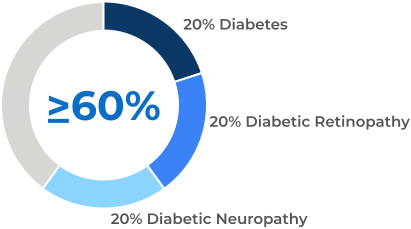
A veteran suffers from several service connected disabilities such as diabetes and diabetic retinopathy and neuropathy. These disabilities arise from a common cause (the diabetes). The ratings need only combine to a 60% evaluation in order for the veteran to qualify for IU.
Scenario 2: Single Standalone Condition
Veterans With Two or More Service-Connected Disabilities Must Be Rated With One Disability Rated at or Above

Example
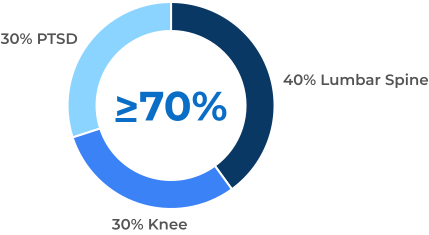
A veteran has ratings of 40% for a Lumbar Spine condition, 30% for a knee, and 30% for his PTSD. VA’s combined rating math results in a 70% rating. Since the veteran’s spine is rated at 40% and he has a 70% total rating, he meets IU.
For the purposes of the IU, VA considers the following combinations as a “single disability”
- One involving one or both arms, or legs, including the bilateral factor
- Disabilities resulting from a common problem or single accident
- Disabilities affecting a single body system (i.e., orthopedic, respiratory
- Multiple injuries incurred in action
- Multiple disabilities incurred as a POW.
Complex case? Get your free legal evaluation
One of our TDIU attorneys will review your case.
Important things to remember about the schedular requirements for TDIU

VA can only consider disabilities that have already been service connected
When making a determination on IU, the VA can only consider disabilities that have already been service connected
Example: If a veteran is service connected for his knees and his back, but in reality could not work due to his PTSD-related anger outbursts (which have not been service connected but are part of a pending claim), VA will only consider the knees and the back when deciding if the veteran can work or not. Until service connection is granted for PTSD (if at all), the veteran must prove that he cannot work due to his knees and back condition alone.

VA cannot consider non-service connected disabilities
When making a determination on IU, the VA cannot consider non-service connected disabilities.
Example: If a veteran has a 70% service connected rating for PTSD and a non-service connected back disability, the VA must review the veteran’s ability to work solely as it pertains to the service connected PTSD. Even if the veteran is receiving worker’s compensation or Social Security Disability for the back injury it doesn’t matter. VA cannot use this information against the veteran. After all, the veteran may not be able to work for more than one reason. Here, if the veteran cannot work due to his service connected PTSD, he should get IU.

Age of the veteran is not a factor
The age of the veteran is not a factor when qualifying for IU. This means the VA cannot state that because the veteran is a certain age he would not be able to work due to age alone.
How Do I Apply To TDUI?
Interestingly enough, you may have already applied for IU without knowing it. A claim for IU is not always a separate, free-standing claim. You ‘officially’ can file an IU claim on a VA Form 21-8940, Application for Increased Compensation Based on Unemployability. However, the evidence in an underlying claim can raise IU too. Two places where this could happen are during a service connection claim or a claim for increased rating. If during one of these claims there is evidence of IU then there is a claim for IU. VA should consider the issue as part of the underlying claim, even if the veteran has not specifically requested IU.
Rarely, does the VA decide IU without the veteran raising the claim first. Further the RO will not grant IU without the veteran submitting VA Form 8940. So if you think you are eligible for IU, submit the 8940.
VA Form 8940 is a rather complex and confusing form.
Here’s how to fill it out:
Section I of the form deals with Disability and Medical Treatment. In this section, the veteran must state what disability keeps her from working. Remember, the veteran’s service connected disabilities alone must keep the veteran from work. If there are any non-service connected disabilities involved VA is not supposed to consider these. That said, the veteran should be proactive. She should get a doctor’s statement showing the service connected disabilities alone keep her from working. There is also a place on the form for medical treatment. The veteran should provide the name and address of where she is treating for the service connected disabilities. It is very important to state the frequency (monthly, weekly, every other week, etc.) of treatment. This is a better practice than giving specific dates of treatment relating to his or her particular disabilities.


Section II of the form asks for all employment history. This goes back for a five-year period preceding the date on which the veteran claims to have become too disabled to work. So, for example, if a veteran stopped working in 2010, work history from 2005-2010 would need to be provided. Additionally, the veteran must provide the names and addresses of the employers. Finally, he must state what type of work was performed, how many hours per week, and the dates of employment.
Section III addresses schooling and other training. In this section, the veteran must state whether she acquired any other training before becoming too disabled to work. Then she must put down if she had any training since becoming too disabled to work. If she had any training, she must specify what kind of training it was. In this the veteran giving accurate and specific information goes a long way to help VA make a timely decision.
It is important to understand that IU is not a freestanding claim, but is part of the rating process. For example, the VA grants a veteran a 70% rating for PTSD, but does not decide the issue of IU. The veteran may think, “Okay, now I have a 70% rating so I can apply for IU.” In truth, what he should do is appeal the decision granting the 70% rating for failure to consider IU. This is important because of the way the VA determines the effective date for IU.
The effective date for IU is often something that the VA gets wrong. The effective date for IU should be the date when VA first received evidence indicating the veteran was unemployable. This could be a doctor’s letter or a note in a medical record. Either of these would need to state that the veteran’s disability interfere with her work. Second, you must determine the status of the veteran’s claims, if any, at the time the VA received this evidence.
There are three main ways to answer the second question:
- VA first received evidence of the veteran’s unemployability when she filed a claim for service connection. Similarly when VA was considering whether to grant service connection. If VA eventually grants service connection for the veteran’s disability and awards IU, the effective date would be either: the date VA received the claim for service connection, or the date the veteran first became unemployable due to his or her service connected disabilities, whichever is later.
- If VA first received evidence of the veteran’s unemployability after VA granted service connection, but before the VA made a final decision on the rating for the disability, the effective date for an award of IU would be: the date the VA received the claim for service connection, or the date the veteran first became unemployable due to his or her service connected disabilities, whichever is later.
- Finally, if the VA first received evidence of the veteran’s unemployability when she filed a claim for an increased disability rating or while a claim for an increased disability rating is pending, the effective date for an award of IU would be: the date VA received the claim for an increase in disability rating, or the date the veteran first became unemployable due to his or her service connected disability ratings, whichever is later.

If I’m Working Can I Get IU?
No. VA unemployability does not always mean that a veteran is not working – the key, however, is where the income comes from. There are two exceptions.
01
All income earned from employment must be at or below the poverty level.
02
Income can be from a job that is considered to be “sheltered”.
Regarding income that is below the poverty level, marginal income, it is not substantially gainful occupation. Marginal employment is considered as “earned annual income that does not exceed the poverty threshold for one person. VA uses income statistics from the US Department of Commerce, Bureau of the Census.” For 2024, the poverty level for which a veteran must be working under is around $15,000.
Common IU Questions
Not able to work because of your VA disability?
We win 96% of the cases we have decided to pursue.
Testimonials
Supporting Veterans Nationwide
-

I would like to thank the whole Hill & Ponton team that was responsible for completing a successful claim on my behalf. My family and I are forever grateful for your service on my claim. I pray that other veterans who need wise counsel and advocacy will contact you. May God bless each and everyone of you.
– Thomas Sedgwick
-

Thank you to the firm of Hill & Ponton!! Brian Hill and his staff were able to get my 100% disability with the VA for my exposure to herbicides in Thailand. I have been fighting for this for many years and kept getting denied, after consulting with Hill & Ponton I decided to let them help me and it was the best decision I could have made. I found their professionalism to be outstanding.
– Chip P.
-

The service provided by Hill and Ponton was exemplary. The lawyers and staff took care of every aspect with respect and understanding of the clients needs.
In my case, as a new widow, they patiently walked me through each step. They kept me informed of the progress. I cannot say enough about the service they provided. Thank you Brian and staff.– Judith K. Zitzewitz
-

As a Vet you may have filed a disability claim, and if you want to win your claim you need to call Hill and Ponton. I didn’t know what to do about my condition or status until I made the call. At H&P they not only took my case, but made me feel like family. They changed my life and they will change your life too. It’s true! In my opinion you can’t do better and you won’t regret it!
– Paul K