
The military stored Agent Orange at Johnston Atoll from 1972 to 1977 before destroying the stockpile at sea. Veterans who served on the island, or aboard a ship that called there during the qualifying period, now have a presumption of herbicide exposure under the PACT Act.
That presumption removes a major burden from a claim: veterans do not have to prove they handled the drums or entered the storage yard. With qualifying service and a covered diagnosis, veterans may receive disability benefits without a separate medical opinion linking the disease to Agent Orange.
- Qualifying service is from Jan. 1, 1972, through Sept. 30, 1977. Veterans must have served on Johnston Atoll or aboard a ship that called there during that period. Passing through nearby waters alone does not qualify.
- Veterans do not need evidence of personal contact with Agent Orange when their records establish qualifying Johnston Atoll service.
- Eligible survivors may qualify for Dependency and Indemnity Compensation (DIC) when a service-connected condition caused or contributed to the veteran’s death.
What Happened to the Agent Orange Stored at Johnston Atoll?
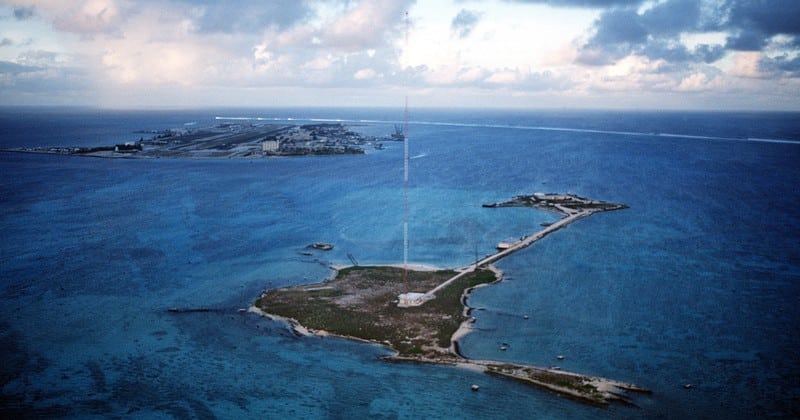
In 1972, Operation Pacer IVY moved the remaining Agent Orange stock from Vietnam to Johnston Atoll. The shipment included drums from Tuy Hoa Air Base, loaded at Cam Ranh Bay, and stock loaded at Saigon. The historical removal account describes approximately 25,000 55-gallon drums, or about 1.4 million gallons.
VA’s herbicide storage records date the Johnston Island storage operation from April 18, 1972. Crews placed the drums in the Herbicide Area on the island’s northwest corner. The Environmental Protection Agency’s reports that more than 1,200 military and contractor personnel lived on the island at one point in its military history.
The military destroyed the stored Agent Orange at sea in 1977, in Operation Pacer HO which used the Dutch ship M/T Vulcanus for incineration. The later Johnston Atoll Chemical Agent Disposal System, or JACADS, handled a separate chemical-weapons stockpile.
Who Qualifies for the Johnston Atoll Agent Orange Presumption?
The PACT Act’s exposure provisions expanded the locations where VA presumes herbicide exposure. For Johnston Atoll, veterans need qualifying active service on the atoll or aboard a ship that called there between Jan. 1, 1972, and Sept. 30, 1977.
Section 403 of Public Law 117-168 established that coverage. Once the service requirement is met, veterans do not need separate evidence that they handled Agent Orange or worked near leaking drums.
The diagnosis remains a separate part of the claim. A veteran with a condition covered by the herbicide presumptive rules generally does not need a medical nexus opinion linking that condition to the exposure. A condition outside the list still requires evidence supporting its connection to service.
Does Service in Johnston Atoll’s Territorial Waters Count?
A ship’s passage through Johnston Atoll’s offshore waters does not, by itself, meet the presumption. The law covers service on the atoll or aboard a ship that called there. It does not extend the same territorial-waters language used for Guam and American Samoa to Johnston Atoll.
Veterans whose ships only passed nearby may still pursue benefits with evidence of actual exposure. Service outside the qualifying dates also requires evidence supporting exposure rather than relying on the Johnston Atoll presumption.
If a DD-214 does not identify a temporary assignment or a brief ship call, personnel records, temporary-duty orders, unit histories and deck logs can help establish where the veteran served and when the ship visited.
How to prove exposureWhat Conditions Qualify for Agent Orange Disability Benefits at Johnston Atoll?
Veterans with qualifying exposure may receive presumptive service connection for the following conditions, subject to the applicable diagnosis, severity and timing requirements. The list comes from the herbicide presumptive rules in 38 C.F.R. § 3.309 and the PACT Act’s additions:
- AL amyloidosis
- Bladder cancer
- Chloracne or a similar acneform disease
- Chronic B-cell leukemias
- Type 2 diabetes
- Hodgkin’s disease
- Hypertension
- Hypothyroidism
- Ischemic heart disease
- Monoclonal gammopathy of undetermined significance (MGUS)
- Multiple myeloma
- Non-Hodgkin’s lymphoma
- Parkinson’s disease and parkinsonism
- Early-onset peripheral neuropathy
- Porphyria cutanea tarda
- Prostate cancer
- Respiratory cancers of the lung, larynx, trachea or bronchus
- Certain soft tissue sarcomas
Chloracne, porphyria cutanea tarda and early-onset peripheral neuropathy generally must become at least 10% disabling within one year of the last herbicide exposure, under 38 C.F.R. § 3.307. Veterans did not have to receive a VA rating during that year; the evidence must show that the condition met the required severity. Other listed conditions may appear years later and still qualify.
A disease outside the list may qualify through direct service connection when the evidence links it to military service, including established herbicide exposure. A separate route, secondary service connection, applies when an existing service-connected disability causes or aggravates another condition.
How Has the Board of Veterans’ Appeals Ruled on Johnston Atoll Agent Orange Claims?
An analysis of 31 Board of Veterans’ Appeals decisions from 2018 through 2026 involving Johnston Atoll herbicide claims found 15 favorable decisions, five denials and 11 remands for further development. This is only a fraction of all VA appeals, as the Board tends to handle the most complicated or disputed cases. They can be useful because they show what kind of evidence was considered.
| Outcome | Decisions | Share |
|---|---|---|
| Favorable grant | 15 | 48.4% |
| Denied | 5 | 16.1% |
| Remanded | 11 | 35.5% |
| Total | 31 | 100% |
These figures describe the reviewed decisions, not a VA-wide approval rate or a veteran’s chance of success. Under 38 C.F.R. § 20.1303, Board decisions apply to the individual cases decided and do not establish binding precedent for other veterans.
What Gets a Claim Approved by the Board?
The most straightforward path to an approval involves qualifying service and a presumptive diagnosis under the PACT Act.
In BVA Citation No. 24015334, decided April 9, 2024, the Board granted service connection for ischemic heart disease and hypertension. Personnel records showed service aboard the USS Enhance from September 1972 to July 1973, and the Board found that the ship called at both Johnston Atoll and Guam in 1973.
The Board relied on qualifying service at those locations to presume herbicide exposure. Medical records established both diagnoses, and the Board granted both claims under the PACT Act.
For a condition outside the Agent Orange presumptive disease list, veterans need evidence establishing the connection to the exposure. The Board considered a veteran’s storage-supply duties, testimony about daily contact with chemicals and records placing the veteran at Johnston Island.
Why Claims Were Denied
Cases were typically denied when service fell outside the dates now covered by the Johnston Atoll presumption and when the evidence did not establish actual exposure.
In BVA Citation No. 19103782, decided Jan. 16, 2019, the Board denied service connection for prostate cancer. The veteran initially described temporary duty from 1987 to 1989. Supporting statements led the Board to accept that the veteran visited Johnston Island at various times from 1986 onward.
The dispute concerned exposure rather than presence on the island. The Board considered accounts of work near the former storage area, diving, locally caught fish and an environmental study. It found that this evidence did not establish herbicide exposure during the later assignments and gave greater weight to the government’s historical-records review.
That decision predates the PACT Act. The service dates it addressed also fall outside the Johnston Atoll period the law later covered. For conditions outside the presumptive list, proving exposure alone does not establish service connection. The evidence must also address the relationship between the diagnosed condition and service.
Why the Board Remanded Cases
11 of the 31 reviewed decisions resulted in remands, meaning the Board returned an issue for further work instead of making a final decision on entitlement. These were associated with gaps in personnel records, opinions that addressed radiation or another toxin without considering herbicides, and medical conclusions that failed to engage with favorable statements or environmental evidence.
In BVA Citation No. A26024810, decided March 19, 2026, the Board remanded claims for type 2 diabetes, benign essential hypertension and coronary arteriosclerosis. A November 2023 VA memorandum recognized presumed herbicide exposure based on service involving American Samoa and Johnston Atoll. A December 2023 memorandum reached the opposite conclusion. VA relied on the later memorandum without addressing the conflict, so the Board directed the agency to clarify the correct exposure findings. The Board also found the medical opinions inadequate: the examiner listed other risk factors but did not adequately explain why they outweighed the veteran’s toxic exposures. The remand required clarification of exposure and new medical opinions.
Get Help with a Johnston Atoll Agent Orange Claim
Hill & Ponton represents veterans and survivors in appeals after VA denied a claim, sent back the case for more development, assigned a low rating or refused to grant individual unemployability.
Eligible surviving spouses, children and parents may qualify for Dependency and Indemnity Compensation when a service-connected disability caused or contributed to the veteran’s death. When VA did not establish service connection during the veteran’s lifetime, a survivor may still establish qualifying Johnston Atoll service and the disease’s connection to service.
Hill & Ponton was founded in 1986 and has a 96% success rate for accepted VA cases, with no upfront costs to the veterans or their families, and a fee collected only after winning and recovering retroactive benefits.
If VA denied your claim, assigned a rating that’s too low, or sent back the appeal for more development, request a free case evaluation to discuss your options.
Content Reviewed By

Jacqueline Imboden
Sr. Claims Advocate
Jacqueline Imboden joined Hill & Ponton in March 2025, bringing over two decades of experience from the VA, where she led projects related to disability benefit programs, including addressing issues of military exposures. As a military spouse with an extensive background in Veterans' affairs, as well as a Master's degree in Public Administration and Executive Leadership, she has a deep understanding of the challenges faced by service members, Veterans, and their families.
Written By
Michallie Harrison
Michallie K. Harrison is a retired U.S. Army Sergeant First Class with 21 years of service, including three combat tours. She holds a Bachelor of Arts in Liberal Studies with an emphasis in history, criminal justice, and administration and is currently pursuing a second bachelors degree in mass communications with a minor in creative writing. A 100% permanently and totally disabled veteran as rated by the Department of Veterans Affairs, she applies her background in military journalism and investigative research to produce precise, analytical, and well-researched work.