
When the VA denies a claim, the denial letter is supposed to say what was decided, what evidence the VA looked at, what rules applied, and how the decision might be challenged.
But when VA fails to provide proper notice, a veteran may argue that the decision never became final. If the letter is missing required information (“insufficient notice”), your claim could be legally considered still pending, even if the appeal deadline appears to have passed.
A February 2026 Federal Circuit ruling and a long-running defect in a standard VA form have put this issue front and center for veterans who filed supplemental claims between February 2019 and September 2024.
When the VA fails to provide complete notice as required by law, the decision remains pending until the VA fixes it. That principle comes from DiCarlo v. Nicholson, 20 Vet. App. 52 (2006), and it still controls today.
What “Sufficient Notice” Means Under Current VA Law
Since February 19, 2019, the Appeals Modernization Act (AMA) has set a higher bar for what a VA decision letter must contain.
The Eight Required Elements of Every Decision Letter
- Identification of the issues the VA decided
- A summary of the evidence the VA considered
- A summary of the laws and regulations the VA applied
- A list of any findings the adjudicator made in your favor
- If your claim was denied, the specific element of the claim that was not met
- If applicable, the criteria the VA needs to grant service connection or move you to a higher rating
- An explanation of how to obtain or access the evidence the VA used
- A summary of your review options
Your Right to a Hearing, Representation, and Review
According to VA regulation 38 CFR § 3.103(b)(1), the decision notice must set forth:
- Your right to a hearing on any issue in the claim
- Your right to be represented by an attorney, accredited agent, or veterans service organization
- The procedures and time limits to request a Higher-Level Review, a Supplemental Claim, or a Board appeal
2026 Update: A Higher Standard for Notice Requirement
On February 4, 2026, the U.S. Court of Appeals for the Federal Circuit issued Hammill v. Collins, No. 2024-1543, which stated:
“The AMA not only changed the overall structure of the veterans appeals system but deliberately and clearly heightened the notice requirement for VA’s initial decisions beyond what was previously acceptable in the pre-AMA regime.”
This supports the argument that VA decision letters issued under the AMA, beginning February 19, 2019, must be judged under a stricter notice standard than older legacy decisions. The Hammill case involved the “implicit denial” doctrine, but its reasoning may help veterans argue that other AMA notice defects also matter.
A Real Example: The Form 20-0998 Defect (2019 to 2024)
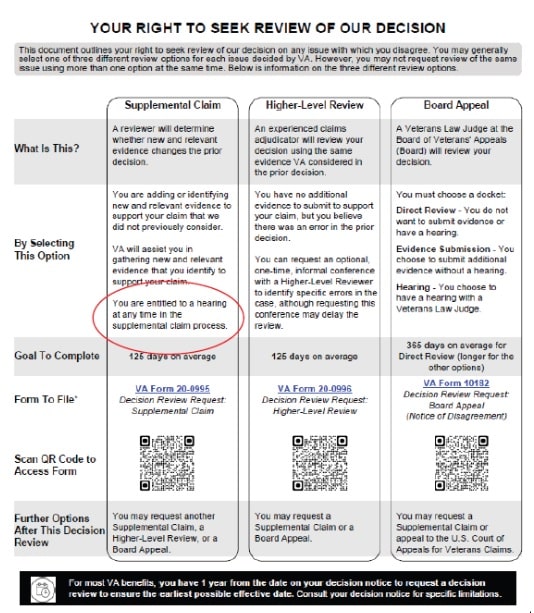
Every VA decision letter comes with an explanatory page called Form 20-0998, “Your Rights to Seek Review of Our Decision.” The form is the table that lays out your three review options: Supplemental Claim, Higher-Level Review, and Board Appeal.
From February 19, 2019 through approximately September 2024, the version of Form 20-0998 sent by the VA was missing one specific piece of required information: the right to a hearing in the supplemental claim process.
Under 38 CFR § 3.103(b)(1) and § 3.103(d)(1), claimants are “entitled to a hearing on any issue involved in a claim… before VA issues notice of a decision on an initial or supplemental claim.”
The pre-September-2024 form did not say so. It described the supplemental claim option as evidence gathering only.
The VA quietly fixed the form in the April 2024 version, which was actually distributed around September 2024. The corrected version contains this line: “You are entitled to a hearing at any time in the supplemental claim process.”
The correction can support an argument that the prior versions of the form did not fully advise claimants of their rights during the process.
Did this happen to you? Get a free reviewWhat the VA’s Error Means for You
If you filed a supplemental claim between February 19, 2019 and September 2024 and the VA denied it, your decision letter probably contained a version of Form 20-0998 with the defect.
That gives you grounds to argue the VA never provided sufficient notice of your appeal rights. If that argument succeeds, the denial could still be pending, even if the one-year window to appeal has otherwise expired.
What Should You Do?
- Pull your old decision letters. Find every VA decision letter you received from 2019 through 2024, especially any that denied a Supplemental Claim.
- Look at the Form 20-0998 attachment. It is the page titled “Your Rights to Seek Review of Our Decision” with three columns. Read the Supplemental Claim column. If it does not say you are entitled to a hearing in that process, your letter has the defect.
- Do not file a new claim without legal advice. If your old decision is still pending as a matter of law, filing a fresh claim could cost you years of back pay. Talk to an attorney first.
- Get a free case evaluation. We can pull your decision letters, check them against the AMA notice requirements, and tell you whether you have grounds to challenge the decision.
What Do You Stand to Gain?
- Earlier effective date. The effective date controls how far back VA pays you and could go back to the date of the original claim, not a later date you had to refile.
- Back pay. If the case is treated as still pending, retroactive payments potentially cover the years the VA wrongly treated the file as closed.
- A second chance. A pending decision lets you submit new evidence, request a hearing, and pursue review without losing your place in line.
This is not a guaranteed win. The VA pushes back hard on insufficient notice arguments because they reopen cases the agency considers settled. You’ll have to prove that the insufficient notice affected what you did, or did not do, after the decision.
Expect the VA to insist that the missing information did not harm you. Expect to need an attorney who can define and explain the error, leverage the Hammill case, and show how the missing notice prejudiced your claim.
Know Your Rights and Take Action
Insufficient notice is not just a Form 20-0998 problem. The same legal framework applies to every required element of a VA decision letter. If your letter skipped the favorable findings, the criteria for a higher rating, or the explanation of how to access your file, the decision may still be deemed pending.
The VA processes millions of claims a year. Form templates, automated letters, and rushed adjudication create gaps. The Federal Circuit’s 2026 ruling in the Hammill case could make some of those gaps actionable in a way they were not under the old rules.
If your VA decision letter was missing required information, request a free case evaluation from Hill & Ponton. We charge nothing upfront and our team has helped veterans recover benefits and back pay in cases the VA considered closed for years.
Written by