
For more than three decades, the VA used an automated computer program to clean up its appeals database. The program closed cases based on what its records showed, but the records were often weeks behind. Because of this, tens of thousands of veterans were left with unprocessed appeals – and the VA never told them.
Veterans who filed their appeals on time and submitted all the paperwork waited for years for a VA decision, not knowing that their cases had silently been closed. No letter. No update.
The Freund v. Collins class action settlement is now forcing the VA to find those closures, reopen them, and notify the veterans affected.
If you filed a VA disability appeal between December 12, 1990 and February 6, 2025 and never heard back from the Board of Veterans’ Appeals, this settlement may apply to you.
Surviving spouses, children, and other dependents who can substitute for the original claimant are also covered.
Get a free review of your caseMore than 90,000 Veterans May Have Been Affected
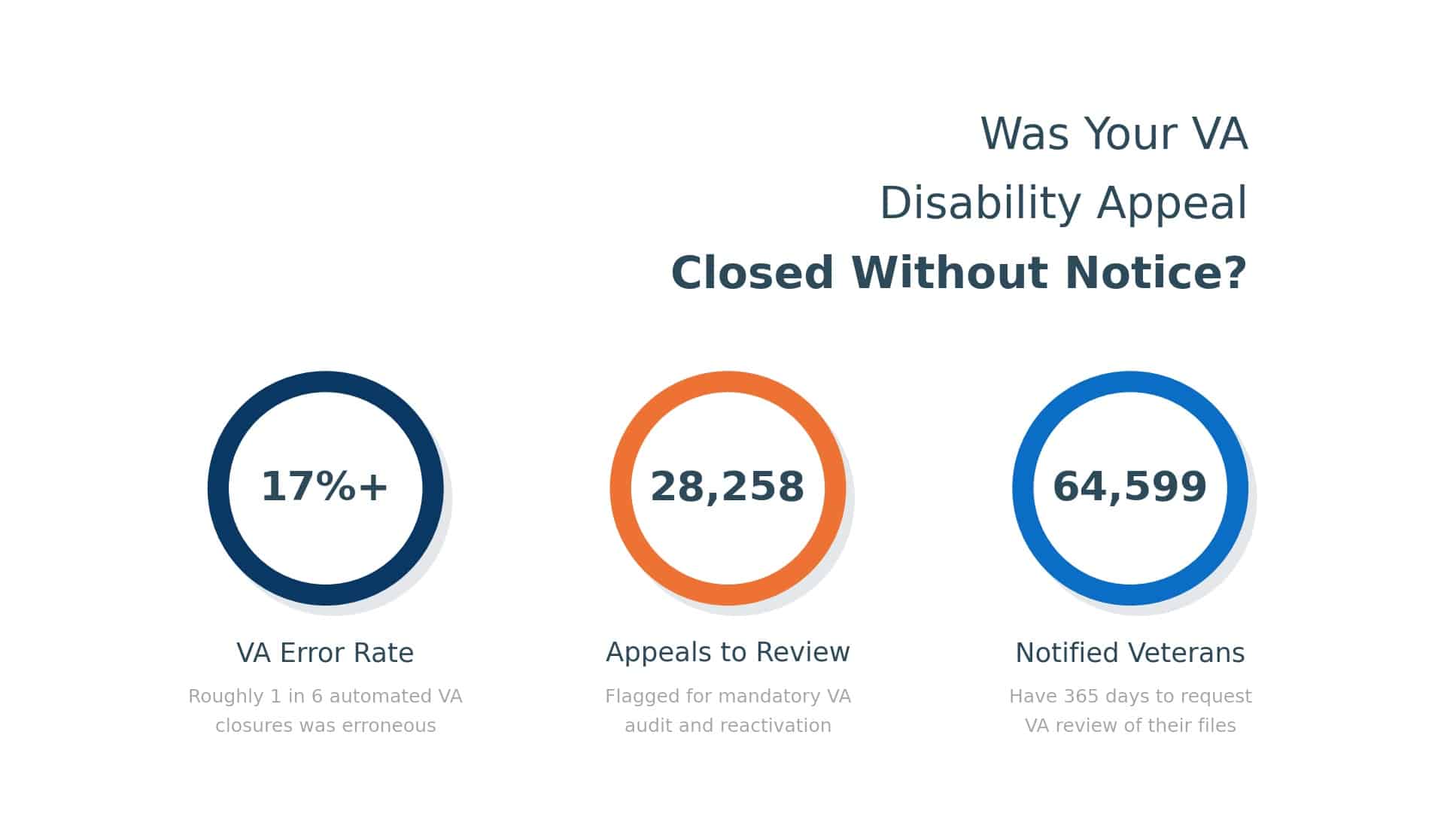
- The VA’s Office of Inspector General reviewed legacy appeal closures and found that roughly 1 in 6 automated closures was erroneous, more than 17 percent
- 28,258 core class files were flagged for mandatory audit by the VA
- An additional 64,599 veterans are receiving individualized notices with 365 days to request VA review of their files
A Real Example: How One Veteran Lost 15 Years to a Program Error
1. The Initial Denial (2005)
John filed a disability claim for his service-connected back injury. The VA denied part of it. He filed a Notice of Disagreement, the formal “I want to appeal” letter. The VA opened his case in the Veterans Appeals Control and Locator System (VACOLS): the electronic database the VA used to track and manage appeals.
2. John Filed His Substantive Appeal on Time
The VA sent John a Statement of the Case. He had 60 days to file a Substantive Appeal (VA Form 9), which allowed appealing the decision at the highest VA level: the Board of Veterans Appeals. John mailed his Form 9 on Day 55, five days early, and the VA’s regional office received it on Day 60. He did everything right.
3. The Processing Backlog
Government investigators reported that the VA took an average of 43 days, 36 days longer than its own target, to record incoming documents in the database. John’s Form 9 sat in a processing pile, unrecorded.
4. The Automated Sweep Closed John’s Claim
Every month, VACOLS ran a program to sweep out stale cases. Its logic was simple: if the 60-day deadline had passed AND no Substantive Appeal showed as received, close the case. John’s deadline had passed and his Form 9 was not yet in the database. The program closed his case. No notice was ever sent.
5. John Waited 15+ Years
Three days after the sweep, a clerk finally entered John’s Form 9 into VACOLS. But his file was already closed and the VA took no action to reopen it.
John assumed his appeal was sitting in the normal Board queue, where wait times stretched for years. He kept waiting. 2006. 2010. 2015. 2020. His appeal was frozen the entire time.
6. The Freund Settlement Reopens His Case
On March 18, 2026, the U.S. Court of Appeals for Veterans Claims certified Freund v. Collins (Case No. 21-4168) as a class action. Under the proposed settlement, the VA must audit 28,258 flagged files, reactivate any that were wrongly closed, and notify the affected veterans. Notices began going out in April 2026.
What You Should Do If You Think You Are Affected
- Watch your mail. Notices began going out in spring 2026. Read every envelope from the VA carefully and do not assume it is junk.
- Do not wait. If an appeal you filed went silent and you have heard nothing for years, do not rely on the VA’s outreach to find you. The audit is large, and individual files can be missed.
- Get a free case review. Reactivation puts you back in line, but it does not win your appeal. You still need to build the evidence, frame the argument, and pursue every dollar of back pay you are owed.
What the Freund Settlement Requires the VA to Do
- Manually review all 28,258 identified appeal files and reactivate any that contained a timely Substantive Appeal.
- Send individualized notices to 64,599 additional claimants whose files contain documents that may qualify as timely appeals, giving them one year to request VA review.
- Complete those actions within 18 months of court approval.
- Notify each claimant of any reactivation and of the next steps in the appeal.
The class period covers any appeal closed between December 12, 1990 and February 6, 2025 on the ground that no timely Substantive Appeal was filed, where the case remains closed.
Not sure what kind of appeal you filed all those years ago? We can check your VA records and find out if your case was closed erroneously.
You Still Have to Prove Your Case (and We Can Help)
Many reactivated cases will need fresh medical evidence, updated lay statements, and argument addressing how the veteran’s condition has worsened over the intervening fifteen or twenty years. Additionally, the AMA reform that took effect on February 19, 2019 brought changes to the appeals process.
Hill & Ponton has handled both legacy and AMA appeals for veterans across the country. Our team knows how to push a Board case forward, build the missing evidence, and pursue every benefit, including back pay.
We’ll Fight on Your Behalf with No Upfront Costs
If you, a parent, or a spouse ever filed an appeal that vanished into the VA system, the Freund settlement may be the solution to finally getting what you’re owed. Request a free, no obligation review of your appeal and let us see how we can help you.
We charge nothing unless we win, and our VA-accredited disability lawyers have decades of experience assisting veterans who were unfairly denied by the VA.
Written by