
Roosevelt Roads Naval Station
Roosevelt Roads, Ceiba
 Known Toxins
5
 Years of Operation
1943-2004 ; 2025-Present
Base Background
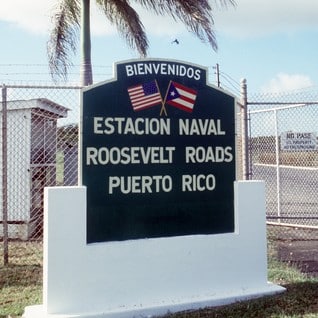
Naval Station Roosevelt Roads sits on the eastern coast of Puerto Rico in the municipality of Ceiba, on a peninsula bordered by the Caribbean Sea on three sides. The Navy named the site for Franklin D. Roosevelt, who identified it as a strategic anchorage location as assistant secretary of the Navy in 1919, and construction moved forward once President Roosevelt ordered the base built in 1940. Commissioned as a Naval Operations Base in 1943 and re-designated a full Naval Station in 1957, Roosevelt Roads grew into one of the largest naval facilities in the Atlantic, with a deep-water port at Ensenada Honda, a runway topping 11,000 feet, and more than 8,600 acres supporting fleet training and logistics for the Caribbean.
The Navy formally closed the station on March 31, 2004, once the closure of the adjacent Vieques training range made the base’s support role unnecessary. The former base’s airfield, now José Aponte de la Torre Airport, has operated as a public-use civilian airport since 2008. After more than two decades of inactivity, the Navy resumed active military operations at Roosevelt Roads in November 2025 as part of a broader U.S. military buildup in the Caribbean.
Toxic Exposure at Roosevelt Roads Naval Station
Roosevelt Roads operated for more than sixty years as a fully self-contained naval station, complete with its own fuel depots, a thermoelectric power plant, and on-site landfills. The Environmental Protection Agency has identified 82 separate sites at the former base needing environmental assessment or cleanup, and it oversees the Navy’s ongoing corrective action work there under a 2007 federal consent order.
Roosevelt Roads may also come up in Agent Orange claims from Puerto Rico veterans, but DoD’s historical herbicide-testing records don’t place the station among the island’s documented testing sites, and Puerto Rico was removed from VA’s presumptive location list in 2020. A veteran pursuing that kind of claim needs evidence tying their duties to an actual testing event. Our lawyers with Agent Orange experience may be able to help.
PFAS Contamination
Like hundreds of other military installations, Roosevelt Roads used aqueous film-forming foam (AFFF) containing per- and polyfluoroalkyl substances (PFAS) in firefighting and training activities for decades. A Department of Defense report to Congress found PFOS at levels as high as 491,401 parts per trillion and PFOA at levels as high as 351,375 parts per trillion in groundwater at the site, both far above the EPA’s 70 parts per trillion health advisory threshold for the two chemicals combined. Find out more about AFFF and VA compensation.
Petroleum Hydrocarbons
Decades of fuel storage and handling at the base’s Tow Way Fuel Farm left a large plume of phase-separated petroleum hydrocarbons, more than 200,000 gallons by EPA’s estimate, floating on the groundwater beneath the site, along with dissolved petroleum contamination in the groundwater and contaminated soil. The releases came from leaking storage tanks and nearby sludge burial pits used during the base’s operating years.
Chlorinated Solvent Contamination
A separate groundwater release near the Tow Way Fuel Farm, cataloged by EPA as its own site, SWMU 55, consists of a plume of chlorinated solvents. Unlike the petroleum contamination nearby, this release was not connected to the fuel storage tanks themselves, and EPA has continued to identify it as a distinct area requiring investigation and cleanup.
Polychlorinated Biphenyls (PCBs) and Asbestos
The base’s long-closed thermoelectric power plant is documented by EPA as a source of both PCB and asbestos contamination. Transformer fluids containing PCBs contaminated concrete surfaces inside the plant, and asbestos-containing materials are present in the same building. Outside the plant, PCB-contaminated soil, underground cooling-water tunnels running to Ensenada Honda and Puerca Bay, and two 50,000-gallon underground fuel tanks all contained PCB-laden sludges, oils, and water. The Navy removed the contaminated soil in 1994 and cleaned and sealed the tunnels and tanks in 1996 as interim measures.
Getting Compensation
Those who spent time working or living at Roosevelt Roads over its long history as an active naval station could have absorbed these substances without any way of knowing it, and conditions linked to that kind of exposure often don’t show up for years or even decades. A veteran who served there and was later diagnosed with a related illness may still be able to pursue a claim and win disabled veteran benefits.
The chart below shows which health conditions have been connected to this base’s documented contamination. Hill & Ponton’s VA-accredited lawyers have successfully handled toxic exposure claims for Puerto Rico veterans and their survivors for decades, working on contingency with no upfront cost. A free case evaluation is the fastest way to find out if you have a claim that we could win for you.
Known Toxins
The following chart outlines the medical conditions associated with toxic exposure at this base, classified by the strength of evidence required (strong, good or limited).* Please keep in mind that it is not a complete list.
| Toxin | Potential Effects & Strength of Evidence Needed | |||
|---|---|---|---|---|
| Strong | Good | Limited | ||
| Asbestos | Potential Effects & Strength of Evidence Needed | Pulmonary fibrosis Pneumoconiosis... Pleural disease (effusions,plaques,thickening) Asbestosis |
Stomach cancer Renal (kidney) cancer... Immune suppression Autoimmune antibodies, positive ANA |
Ovarian cancer Myelodysplastic syndrome... Multiple myeloma Melanoma Lymphoma non Hodgkin's Laryngeal cancer Colorectal cancer Bladder cancer Adult-Onset Leukemias |
| Chlorinated Solvents | Potential Effects & Strength of Evidence Needed | - | Childhood Leukemias Adult-Onset Leukemias |
- |
| Petroleum hydrocarbons | Potential Effects & Strength of Evidence Needed | Methemoglobinemia |
Cataracts Anemia hemolytic |
- |
| PFAS (Firefighting Foam) | Potential Effects & Strength of Evidence Needed | - | - | Testicular cancer Renal (kidney) cancer... Prostate cancer |
| Polychlorinated Byphenyls (PCBs) | Potential Effects & Strength of Evidence Needed | Thyroid disorders Hypothyroidism Porphyria toxic... Developmental Delay Decreased I.Q../Mental retardation Cirrhosis Chloracne Behavioral problems ADD/ADHD, hyperactivity |
Peripheral neuropathy Pancreatic cancer... Menstrual disorders Lymphoma non Hodgkin's Low birth weight/Small for Gestational Age Immune suppression Hepatocellular cancer (Liver cancer) Dyslipidemia, hypercholesterolemia Delayed growth Congenital malformation Cranio Facial Cognitive impairment (includes impaired learning, impaired memory, and decreased attention span) Bronchitis chronic Acute hepatocellular injury (Hepatitis) Abnormal sperm (morphology, motility, and sperm count) |
Testicular cancer Reduced Fertility Female (infertility and subfertility)... Parkinson's disease/Movement disorders Hypoactivity Hypertension Hyperkeratosis/Hyperpigmentation Hearing loss Endometriosis Diabetes Type I Breast cancer Bone cancer/Ewings sarcoma Altered time to sexual maturation (accelerated or delayed puberty) Altered sex ratio |
*Effects are according to the Center for Disease Control and Prevention’s Agency for Toxic Substances & Disease Registry unless otherwise noted.
Anyone who served at Roosevelt Roads and was later diagnosed with a condition linked to toxic exposure may have grounds for a VA disability claim. Our VA-accredited lawyers handle toxic exposure claims for previously denied veterans: get a free case evaluation today to discuss your options.