
Carpal tunnel syndrome significantly impacts veterans, largely due to repetitive wrist and hand motions involved in military roles, such as operating heavy equipment, typing, and extensive manual tasks.
Research indicates that within the U.S. military population, the overall incidence of CTS is 3.98 per 1,000 person-years. Additionally, female veterans have a much higher rate at 8.69 per 1,000 person-years compared to male veterans at 3.09 per 1,000 person-years.
The risk of developing CTS increases with age, peaking at 9.08 per 1,000 person-years among those 40 and older. Senior enlisted personnel and senior officers face higher incidences, potentially due to longer service duration and cumulative occupational exposures.
If you’ve developed carpal tunnel syndrome related to your military service, you’re likely eligible for disability compensation and other benefits through the United States Department of Veterans Affairs (VA).
Service Connecting Carpal Tunnel Syndrome
Carpal tunnel syndrome can be linked to military service either directly or through another condition (listed below).
What Causes Carpal Tunnel Syndrome?
CTS results primarily from repetitive hand motions and prolonged wrist flexing or extending. Other health issues may also contribute, including:
- Diabetes
- Rheumatoid arthritis
- Thyroid gland imbalances
- Wrist fractures or trauma
- High blood pressure
Direct Service Connection
To establish a direct service connection, you must provide medical records showing the diagnosis, progression, and treatment of your CTS.
You also need a strong nexus letter from a medical professional connecting your condition to specific activities or duties performed during military service.
Examples of common military tasks that cause carpal tunnel issues include:
- Repetitive handling of heavy equipment, weaponry operation, and other repetitive manual labor
- Prolonged typing or computer use
- Mechanical maintenance tasks
Secondary Service Connection
Secondary service connection applies when your condition arises as a result of another disability already recognized by the VA.
For instance, conditions such as arthritis or diabetes that are service-connected could lead directly to developing carpal tunnel syndrome.
To establish secondary service connection, you must submit medical evidence that clearly demonstrates a causal relationship between your primary service-connected disability and the onset or worsening of carpal tunnel symptoms.
What If the VA Denies Your Case?
If the VA denies your claim for carpal tunnel syndrome, you have the option to appeal the decision. Consider getting assistance from a VA disability lawyer who can fight on your behalf.
Did VA Deny Your Disability Claim?
What Is the VA Disability Rating for Carpal Tunnel Syndrome?
CTS is rated at 10% or more, depending on the severity of the condition and whether the dominant or non-dominant hand is affected.
The VA assesses carpal tunnel syndrome under 38 CFR § 4.124a, specifically Diagnostic Code 8515 for the paralysis of the median nerve.
| Severity Level | Dominant Hand | Non-Dominant Hand | Criteria & Symptoms |
|---|---|---|---|
| Complete Paralysis | 70% | 60% | Inability to make a fist or move the thumb; significant muscle atrophy (wasting). |
| Severe Incomplete | 50% | 40% | Considerable loss of motor and sensory function. |
| Moderate Incomplete | 30% | 20% | Noticeable functional loss and sensory disturbances. |
| Mild Incomplete | 10% | 10% | Mild tingling or numbness without significant motor impairment. |
Bilateral Carpal Tunnel VA Ratings
Veterans with bilateral (both hands) CTS typically receive separate disability ratings for each hand. The VA evaluates the severity and functional limitations of each hand independently, assigning an appropriate rating based on the individual impairment level.
These separate ratings are then combined, and an additional bilateral factor (an extra 10% of the combined rating) is applied, which can significantly increase the overall disability compensation.
Getting a New VA Rating for Carpal Tunnel After Surgery
Following carpal tunnel surgery, the VA re-evaluates your condition to determine if the surgery successfully alleviated symptoms or if ongoing issues persist. Ratings post-surgery are based on residual symptoms, the effectiveness of your recovery, and how much your hand function continues to be affected.
If symptoms such as pain, weakness, or limited mobility remain severe, the VA may maintain a higher disability rating. On the other hand, substantial improvement could result in a lower rating or reassessment at the mild or moderate levels.
How VA Evaluates Carpal Tunnel Syndrome
Before assigning a rating, the VA takes a close look at how your condition shows up in everyday life. Having a diagnosis is one thing, but what really matters is how your symptoms impact your daily routine and ability to work.
- Severity and frequency of symptoms: The VA assesses the severity of your symptoms and how often they occur.
– Severe, constant symptoms typically receive higher ratings compared to mild or intermittent symptoms.
- Dominant versus non-dominant hand: The rating often differs depending on whether the affected hand is your dominant (primary use) hand or your non-dominant hand.
– Ratings tend to be higher when the dominant hand is more impaired.
- Functional impairment and task performance: The VA examines how your condition impacts daily activities, occupational tasks, and overall quality of life.
– Greater functional impairment typically results in a higher rating.
- A Compensation & Pension (C&P) exam is often required to obtain a VA rating.
What to Expect During a C&P Exam
During a C&P exam, a VA-approved doctor will:
- Conduct detailed physical evaluations to assess the extent of your carpal tunnel syndrome, checking for pain, tenderness, swelling, and signs of muscle weakness or atrophy.
- Perform specialized tests such as X-rays, nerve conduction studies, electromyography (EMG), or dexterity assessments to objectively measure nerve function, hand strength, and coordination.
- Clearly document symptoms, physical examination findings, and observed functional limitations.
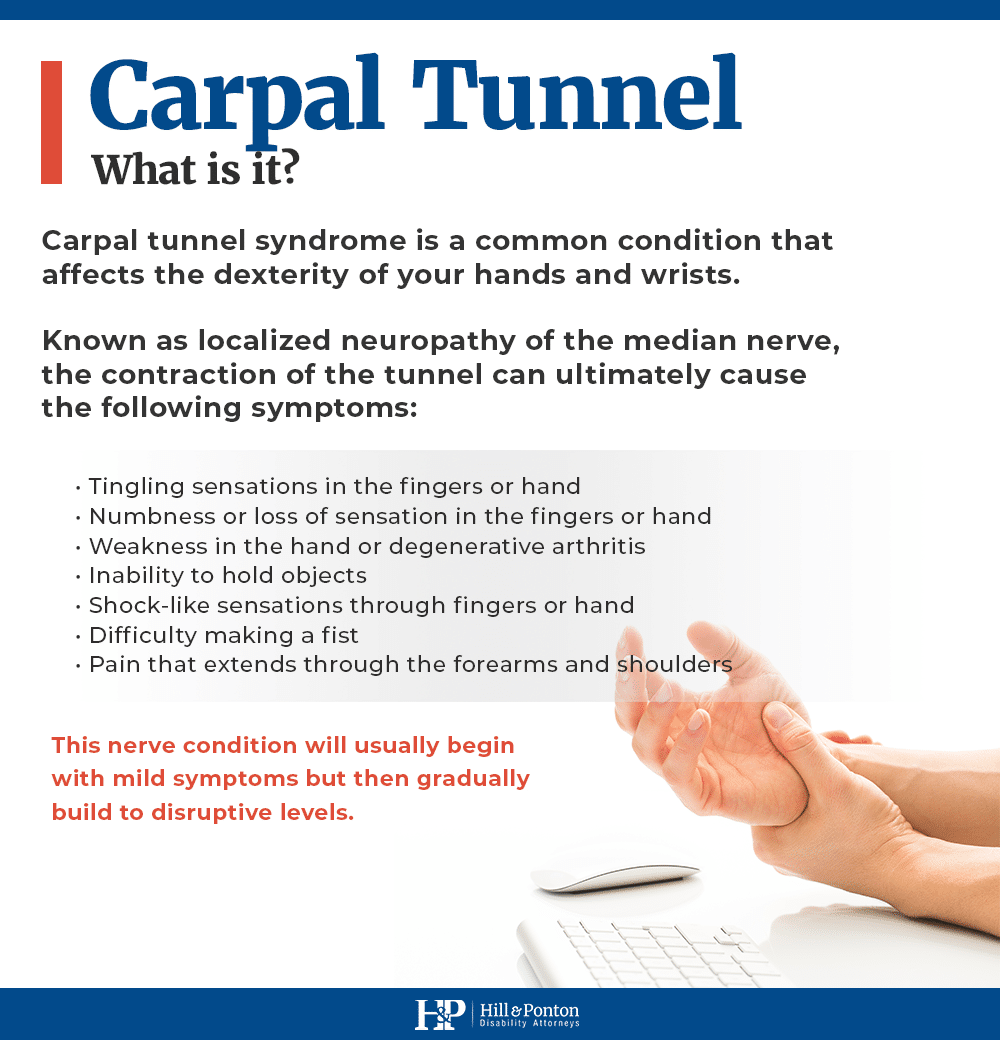
Symptoms of Carpal Tunnel Syndrome
- Tingling or numbness in fingers and hands (incomplete paralysis)
- Weakness and inability to grip or hold objects firmly
- Shock-like sensations radiating through fingers or hand
- Difficulty or pain when forming a fist or grasping objects
- Pain extending into the forearm, elbow, or even up to the shoulder
How to Make a Carpal Tunnel VA Claim
To file a successful VA claim for carpal tunnel syndrome, you will need to:
- Compile thorough medical records and documentation, including diagnoses, treatment history, and physician notes. You also need test results, such as nerve conduction studies and electromyography (EMG), and any relevant medical evaluations.
2. Secure a nexus letter from a qualified medical professional that clearly and explicitly links your carpal tunnel syndrome to your military service or a service-connected disability
Note: This will not be required if there is documentation of the carpal tunnel syndrome in service records.
3. Provide detailed descriptions and examples to show how carpal tunnel syndrome affects your daily activities and functional limitations. Examples include difficulty performing routine tasks, decreased ability to work, challenges with self-care, or diminished quality of life.
Steps in the Claim Process
1. Submit your claim and supporting documents online through the VA’s eBenefits portal, by mail using VA Form 21-526EZ, or in person at your nearest VA Regional Office. If a claim for carpal tunnel syndrome has previously been filed, you will need to file a VA Form 21-0995 with new and relevant evidence.
2. Complete a Compensation & Pension (C&P) exam if the VA requests it. Make sure you attend the scheduled appointment and provide comprehensive details about your symptoms.
3. If your claim is denied or rated lower than expected, appeal promptly and consider legal assistance.
4. Receive a VA decision letter detailing the rating assigned or the reasons for denial.
Get Help With Your VA Disability Claim
Get More Benefits with Carpal Tunnel Secondary Conditions
Carpal tunnel syndrome can lead to other health issues that may qualify the veteran for a higher VA disability rating and compensation. Secondary conditions to carpal tunnel syndrome include:
If you’re looking to maximize your VA disability, get in touch with us for a free evaluation of your case. For over three decades, Hill & Ponton has been dedicated to helping disabled veterans nationwide secure the benefits they rightfully deserve.
CONTACT US TODAY!Content Reviewed by

Ursula has been a key advocate at Hill and Ponton since 2017, specializing in building strong evidence for veterans’ cases. She brings both passion and a personal commitment to serving those who have served our nation since she became an veteran disability attorney. With an impressive academic record—including significant research on systemic issues in the VA claims process that contribute to veteran poverty—Ursula is uniquely equipped to navigate the complexities of veterans’ benefits and legal challenges.
Written by