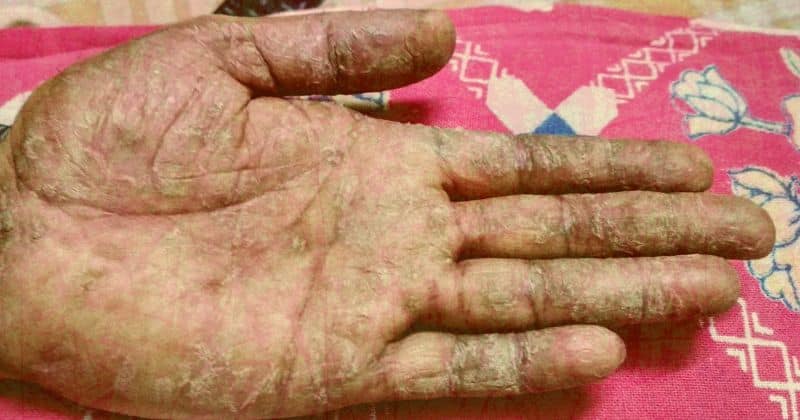

A porphyria cutanea tarda (PCT) diagnosis decades after service need not end an Agent Orange claim. The VA presumes service connection if PCT was at least 10% disabling within a year after the last herbicide exposure, and evidence of symptoms from that year can prove it without a diagnosis. Without that evidence, direct or secondary service connection is still possible.
Is PCT an Agent Orange Presumptive Condition?
Porphyria cutanea tarda is an Agent Orange presumptive condition under 38 C.F.R. § 3.309(e), so the VA assumes herbicide exposure caused it without requiring a medical opinion, as long as the disease became at least 10% disabling within a year after the veteran’s last date of exposure and no evidence rebuts the presumption.
For a Vietnam veteran, the last date of exposure is the last day served in a location covered by the Agent Orange presumption, unless affirmative evidence shows the veteran was not exposed. For example, let’s say a soldier left Vietnam in September 1969. He needed PCT symptoms at the 10% level by September 1970. In a real case (1998 Board decision Nr: 9819036), a veteran whose only service was at Fort Leonard Wood in 1974 lost a PCT claim, in part because nothing corroborated herbicide exposure.
A veteran whose service falls outside the covered locations and dates should review how to prove exposure to Agent Orange before relying on the presumption. Surviving spouses of veterans exposed to Agent Orange may also qualify for VA benefits.
Learn How To File And Win Your VA Claim
Get our FREE book The Road to VA Compensation Benefits.
get the free book
Does VA Require a PCT Diagnosis Within the First Year?
The VA does not require a PCT diagnosis within a year after the last date of exposure. Under 38 C.F.R. § 3.307(c), the characteristic symptoms only have to show up to the 10% level during that year, followed by a definite diagnosis without unreasonable delay. VA regulations say the rule “will not be interpreted as requiring that the disease be diagnosed in the presumptive period,” and they allow “acceptable medical or lay evidence” to show the early symptoms.
However, the VA will not infer that PCT was 10% disabling during the first year just because it was advanced by the time a doctor diagnosed it. So what does a veteran first diagnosed in the 2000s need?
The evidence has to describe what the skin looked like, or what treatment was needed, in the year after leaving the covered location. (PCT is a disorder of a liver enzyme that causes blistering on sun-exposed skin, so the VA measures how much skin that blistering affected and what treatment it required).
The regulation also asks for a diagnosis “without unreasonable time lapse.” This means a long delay gives the VA an argument against the claim. The first-year evidence has to be specific enough to outweigh it.
How to Prove First-Year PCT Symptoms Decades Later
A veteran can prove first-year PCT symptoms with any combination of medical records and credible lay statements describing blistering, scarring, or treatment during that year. The statements from people who saw the symptoms should describe what the witness actually observed during that period.
For instance, a witness would have seen blisters on the face, arms, and hands followed by crusting and scarring, darkened skin, and increased hair growth on sun-exposed areas. Proof that those symptoms appeared in the first year can come from:
- Service treatment records and the separation exam. A rash, blisters, or skin complaint noted near the end of service.
- Early civilian medical records. Visits to a family doctor or dermatologist in the year after discharge count, even under a different diagnosis, such as a sun allergy or rash.
- Statements from people who saw the skin. A spouse, parent, sibling, or fellow service member can describe when the blisters appeared, where on the body, and how they healed.
- Dated photographs. Pictures from the first year home that show blisters or scarring on the hands, arms, or face.
- Pharmacy or treatment records. Prescriptions for medication taken by mouth or by injection during that year, since systemic therapy is one route to the 10% level.
Witness statements work best when they describe symptoms at the 10% level. Under the skin rating formula, that means lesions on at least 5% of the entire body or of exposed areas, or intermittent systemic therapy totaling less than six weeks over 12 months. A statement describing blisters covering both hands and forearms every summer after discharge tells the VA far more than a statement that the veteran “had skin trouble.”
Case Example
A 2008 Board of Veterans’ Appeals decision (Citation Nr: 0816667) shows how lay evidence works. The veteran left Vietnam in September 1969. His service records noted heat rash and foot blisters that summer, and he and his sister testified that water blisters began right after discharge. PCT was not diagnosed until August 2003.
A private dermatologist wrote that Agent Orange exposure “may have caused some degree of liver damage” that increased the veteran’s susceptibility to PCT. A VA dermatologist found it “at least as likely as not” that the PCT was related to presumed Agent Orange exposure. The Board found the evidence “at least in relative equipoise” (roughly balanced) and granted service connection.
Can a Veteran Win a PCT Claim with No Proof of First-Year Symptoms?
A veteran with no proof of first-year PCT symptoms can still win through direct service connection or, if hepatitis C is already service connected, through secondary service connection. If the veteran misses the window, while the presumption does not apply, the veteran can still prove service connection by providing evidence establishing the medical link.
Direct Service Connection
Direct service connection means proving with medical evidence that service actually caused the disease. It does not depend on the one-year rule.
A 2008 Board decision (Citation Nr: 0803295) granted direct service connection for PCT first diagnosed in October 2000. Service records showed no skin problems, but the veteran reported a rash about six months after leaving Vietnam, and 1981 records described years of itching and redness. A private physician called the PCT “almost certainly related” to herbicide exposure in service, and a June 2007 VA examiner found it “very likely” related to Agent Orange. The Board found no competent evidence contradicting those opinions and granted the claim.
Secondary Service Connection
A secondary condition can be either a disability “proximately due to or the result of” a service-connected condition, or a condition that a service-connected disability made worse. The American Porphyria Foundation lists hepatitis C among the triggers for porphyria cutanea tarda, so a veteran with service-connected hepatitis C may have a secondary PCT claim. However, that path still requires a doctor to connect the PCT to the hepatitis C in the veteran’s case.
Both direct and secondary service connection depend on the nexus letter: a medical opinion stating whether a condition is at least as likely as not connected to service, and explaining why.
How Does VA Rate PCT Once Service-Connected?
The VA rates service-connected PCT under Diagnostic Code 7815 in 38 C.F.R. § 4.118, using the General Rating Formula for the Skin. The formula assigns 0%, 10%, 30%, or 60% based on how much skin is affected and how much systemic therapy was required over the past 12 months.
| Rating | Rating Criteria (at least one of the following) |
|---|---|
| 60% | Characteristic lesions involving more than 40% of the entire body or more than 40% of exposed areas affected; or constant or near-constant systemic therapy required over the past 12-month period |
| 30% | Characteristic lesions involving 20% to 40% of the entire body or 20% to 40% of exposed areas affected; or systemic therapy required for a total duration of six weeks or more, but not constantly, over the past 12-month period |
| 10% | Characteristic lesions involving at least 5%, but less than 20%, of the entire body affected; or at least 5%, but less than 20%, of exposed areas affected; or intermittent systemic therapy required for a total duration of less than six weeks over the past 12-month period |
| 0% | No more than topical therapy required over the past 12-month period, and characteristic lesions involving less than 5% of the entire body or less than 5% of exposed areas affected |
Source: 38 C.F.R. § 4.118, Diagnostic Code 7815 and the General Rating Formula for the Skin
Can PCT Be Rated as Scars or Disfigurement Instead?
Porphyria cutanea tarda can be rated as disfigurement of the head, face, or neck under DC 7800, or as scars under DCs 7801, 7802, 7804, or 7805, instead of the skin formula, depending on which disability is predominant. For example, consider a veteran with significant facial scarring. For that veteran, disfigurement may be the predominant disability. However, the formula treats that as an alternative rating, not an added one for the same skin (two skin conditions affecting the same area receive only the highest single evaluation).
Scar RatingsWhat Does the VA Examiner Record at a PCT Exam?
The examiner records which characteristic lesions are visible, what percentage of the veteran’s entire body and of exposed areas (the face, neck, and hands) they cover, and what treatment the veteran needed over the past 12 months. This decides the rating: lesion coverage of 5%, 20%, and 40% separates the 10%, 30%, and 60% levels, and the length of systemic therapy (treatment taken by mouth or injection rather than applied to the skin) separates intermittent use from constant use.
The lesion percentages come from the exam itself, while the therapy question looks back 12 months, so prescription and treatment records from that period are the proof for the therapy criteria.
Can VA Deny PCT Because of Hepatitis C, Alcohol, or Iron Overload?
The VA can deny a PCT claim even when the one-year timing was met, if the evidence supports a medical conclusion that another cause (such as hepatitis C, alcohol, or iron overload), and not military service, produced the disease. Setting aside a presumption this way is called rebutting it, and it is how the VA can deny a presumptive condition.
An alternate cause can also affect a direct or secondary claim, which has no presumption to rebut. In those claims, the VA weighs an examiner’s opinion blaming hepatitis C or alcohol against the veteran’s nexus opinion.
The medical research shows that PCT often has several triggers together. A 2010 study of 143 PCT patients found alcohol use in 87%, smoking in 81%, chronic hepatitis C in 69%, and HFE gene mutations (linked to iron overload) in 53%. Seventy percent had three or more susceptibility factors at once.
The National Academies’ Veterans and Agent Orange: Update 2010 lists “chlorinated hydrocarbons” among the substances that can aggravate the disorder, alongside iron, estrogens, alcohol, and viral hepatitis. In Hill & Ponton’s view, a record showing hepatitis C or heavy drinking proves that one susceptibility factor existed, but it does not show that herbicide exposure made no contribution.
A 2011 Board decision (Citation Nr: 1104800) shows how a PCT claim fails if the alternate cause goes unanswered. The veteran served in Vietnam in October and November 1969. PCT was diagnosed at a VA Agent Orange Registry exam in September 2006, and the earliest skin evidence dated from the mid-2000s, more than 30 years after discharge. A treating dermatologist wrote that the PCT was “most likely due to underlying hepatitis C and/or alcohol consumption.” The Board gave that opinion more weight than the veteran’s lay statements.
What Should a Medical Opinion Address When VA Blames Another Cause?
A medical opinion meant to answer an alternate-cause denial should name each competing cause in the record, explain why herbicide exposure is at least as likely as not a cause or contributor, and tie the conclusion to the veteran’s actual timeline and records. A strong opinion addresses:
- When symptoms began relative to the last date of exposure, citing the records and lay statements.
- Each alternate cause in the file, including when it began and whether it predates the skin symptoms.
- Why multiple susceptibility factors do not exclude a contribution from herbicide exposure.
- Lab and biopsy findings that confirm the PCT diagnosis.
If hepatitis C appears in a veteran’s records, the veteran should expect the VA to raise it. An independent medical opinion from a dermatologist or hepatologist gives the VA and the Board a reasoned conclusion to weigh against an examiner who blamed another cause.
Was PCT Diagnosed in the First Year but Denied Anyway?
A veteran whose PCT was diagnosed or documented in the first year after the last exposure and denied anyway can still return to the VA. An old denial is not necessarily the end of the road.
Denied before PCT became presumptive?
The PCT presumption took effect on Feb. 3, 1994. Before then, a veteran needed proof of a direct link to service. A Vietnam veteran denied in that period may be a Nehmer class member under 38 C.F.R. § 3.816. That regulation defines the class as “a Vietnam veteran who has a covered herbicide disease,” or certain survivors, and it covers every disease presumed under the Agent Orange Act of 1991 other than chloracne. The effective date (the date the VA’s payments start from) is set this way:
- The VA denied PCT in a decision issued between Sept. 25, 1985 and May 3, 1989 because the claim failed to establish that the disease was incurred or aggravated by the veteran’s service. The effective date is the later of the date the VA received that earlier claim or the date the disability arose.
- The PCT claim was pending on May 3, 1989, or the VA received it after that date but before Feb. 3, 1994, when PCT became a presumptive condition. The effective date is the later of the date the VA received the claim or the date the disability arose.
- The claim in either situation reached the VA within one year after separation from service. The effective date is the day after separation.
Keep in mind that Nehmer changes only the effective date. The veteran still has to win service connection for PCT, through first-year symptom proof or a direct or secondary route.
Denied because the VA did not recognize the service location?
If a Blue Water veteran with a claim submitted on or after Sept. 25, 1985, and before Jan. 1, 2020, was denied, and the veteran files again on or after Jan. 1, 2020, for the same condition and wins, the VA treats the date on which the individual filed the prior claim as the filing date.
The VA’s regulatory Korean DMZ herbicide presumption took effect Feb. 24, 2011, for veterans who served in qualifying units between April 1, 1968, and Aug. 31, 1971. Effective Jan. 1, 2020, federal law expanded the covered service period to Sept. 1, 1967, through Aug. 31, 1971. The PACT Act’s location expansion was effective Aug. 10, 2022.
Neither the Korean DMZ provision nor the PACT Act contains a Blue Water Navy-style rule that automatically restores the filing date of a previously denied claim. A veteran whose old denial became final will need to appeal with new and relevant evidence showing service at the covered location.
Denied because the first-year evidence showed PCT below 10%?
A first-year record of mild symptoms can lose under the one-year rule. In that case, the dispute becomes how much skin the first-year records and witnesses show was affected, or how much systemic therapy was used. New statements describing how far the blisters spread, or prescription records from that year, are new and relevant evidence for a Supplemental Claim.
Denied because the symptoms were recorded under another name?
Records from the first year may describe a rash, sun sensitivity, or blisters without naming PCT. Section 3.307(c) recognizes that symptoms “may have no particular significance when first observed” but gain significance “in the light of subsequent developments.” This means a medical opinion reading those entries as early porphyria cutanea tarda is new and relevant evidence the VA has not considered.
How to Get a Denied PCT Claim Reconsidered
For a PCT decision still within its one-year review period, a veteran can choose among three decision review options: a Supplemental Claim, a Higher-Level Review, or a Board Appeal. Once a denial becomes final, the usual route is a Supplemental Claim with new and relevant evidence. For example, let’s say a sibling saw the blisters in the first year after discharge. If the VA has not seen that sibling’s statement before, it qualifies as new and relevant.
A Supplemental Claim can be filed at any time, but one received more than a year after the decision notice usually cannot receive an effective date earlier. Exceptions may include the Nehmer and Blue Water Navy rules, the liberalizing-law provisions in 38 C.F.R. § 3.114, clear and unmistakable error, or a prior decision that never became final. PACT Act location coverage by itself does not restore the filing date of an old, final claim.
Which Review Option Fits the Reason VA Denied the PCT Claim?
- The VA said PCT appeared too late. New first-year evidence, or a new opinion supporting direct service connection, points to a Supplemental Claim.
- The VA relied on an examiner who blamed hepatitis C or alcohol. A stronger independent medical opinion addressing each alternate cause supports a Supplemental Claim. If the existing record already outweighed the examiner and the VA ignored it, a Higher-Level Review can target that error.
- The VA weighed the existing evidence against the veteran. A Board Appeal fits when the dispute is about how the VA weighed the evidence, and a Veterans Law Judge decides the case.
Get Help with Your PCT Claim
Hill & Ponton’s Agent Orange lawyers may be able to assist veterans whose PCT claim the VA denied or whose Agent Orange presumption was rebutted due to alcohol abuse or hepatitis C. Hill & Ponton has successfully represented veterans for 40 years, and disability law is all we do. Our VA-accredited attorneys win 96% of the cases we take on, and charge no fee unless the appeal ends in victory and back pay for the veteran or the surviving family.
Written By

Anne Linscott
Attorney, Hill & Ponton, P.A.
Anne Linscott is an attorney at Hill & Ponton, P.A., dedicated to helping veterans secure the disability benefits they deserve. With a strong background in finance and law, Anne brings compassionate advocacy and a deep commitment to supporting those who have served.