
Kelly Air Force Base
San Antonio, TX
 Known Toxins
6
 Years of Operation
1917-2001
Base Background
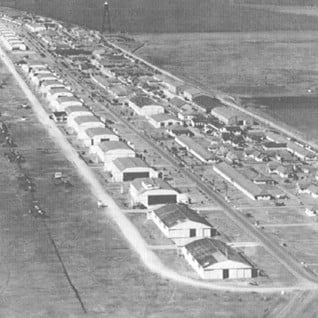
The installation was established March 27, 1917, as one of the Army’s new WWI-era training camps, briefly known as Camp Kelly before being renamed Kelly Field on July 30, 1917. Over the following decades it grew into one of the Air Force’s major aviation training, supply depot, and aircraft maintenance and repair facilities before closing in 2001 under a Base Realignment and Closure decision. About half its acreage, including its runways, was realigned to the neighboring Lackland Air Force Base as the Kelly Field Annex; the other half transferred to Port San Antonio for civilian redevelopment.
Toxic Exposure at Kelly Air Force Base
For decades, Kelly operated as an airfield, fuel depot, and aircraft maintenance and repair facility that included parts cleaning, stripping, painting, and metal plating, leaving behind a well-documented record of chemical, herbicide, and firefighting-foam contamination. Former service members and nearby residents remain affected by that legacy today.
PFAS Contamination
Firefighting foam containing PFOS and PFOA was used at Kelly for decades before the base closed. A 2019 news investigation reviewing the Air Force’s own 2017 groundwater testing found the combined PFOS-and-PFOA reading at the former base reaching 142,000 parts per trillion.
Agent Orange
The VA’s list of domestic herbicide test and storage sites names Kelly Air Force Base as the site of an Agent Orange storage location in Yard 62, East Kelly area, dated November 18, 1970. Despite that documented storage history, Kelly is not on VA’s list of presumptive Agent Orange exposure locations, so a disability claim tied to Agent Orange exposure there needs solid medical and exposure evidence connecting a diagnosis to time spent at the base. If you have a case denied by the VA, get a free, no-obligation review from our team: Hill & Ponton focuses on assisting denied and underrated veterans, with a 96% success rate.
Volatile Organic Compounds and Heavy Metals
The EPA has identified the primary contaminants at the former base as trichloroethylene (TCE), tetrachloroethylene (PCE), benzene, chlorobenzene, and chromium, along with petroleum products, tied to decades of solvent use, parts cleaning, and metal plating. Remaining offsite groundwater plumes, mainly TCE and PCE, drain toward Leon Creek and Six Mile Creek, and nearly 1,000 monitoring wells on and off the former base are still sampled regularly today.
ATSDR’s own review of two on-base drinking-water wells, sealed in 1991 and 1998 after a pipe connecting them leaked, found chloroform and 1,2-dichloroethane at levels that briefly exceeded federal drinking-water screening values in the 1980s, on top of the PCE and TCE already documented nearby. Separate on-base groundwater sampling also turned up mercury and lead, though at concentrations ATSDR concluded were not a health hazard.
Historical Air Emissions
A 2006 ATSDR health consultation traced decades of air emissions from Kelly’s industrial buildings and flight operations. Stationary sources, chiefly five chromium-plating shops and related industrial processes, released tetrachloroethylene (PCE), hexavalent chromium, methylene chloride, methyl ethyl ketone, benzene, ethylbenzene, formaldehyde, toluene, xylene, styrene, naphthalene, acrolein, acetaldehyde, trichloroethylene (TCE), trichloroethane, and dichloroethane. Jet fuel exhaust added more of the same benzene, toluene, xylene, formaldehyde, acetaldehyde, and naphthalene to the air nearby, along with 1,3-butadiene, until the base switched from JP-4 to JP-8 fuel in 1994. ATSDR concluded most of these releases were unlikely to have caused health problems, but it could not rule out a health hazard from hexavalent chromium emitted before 1980, when emissions data from the base’s plating shops was incomplete or missing entirely.
Getting Compensation for Toxic Exposure
Kelly AFB closed in 2001, but its contamination legacy didn’t end there: anyone who served, worked, or lived nearby before then can still develop a related condition today, sometimes decades later. The chart below shows the specific health conditions tied to the toxins documented at the base. Hill & Ponton’s VA-accredited lawyers have decades of experience with this kind of cases, for both veterans and their survivors, working entirely on contingency (no upfront costs). Find out what your case could be worth with a free evaluation.
Known Toxins
The following chart outlines the medical conditions associated with toxic exposure at this base, classified by the strength of evidence required (strong, good or limited).* Please keep in mind that it is not a complete list.
| Toxin | Potential Effects & Strength of Evidence Needed | |||
|---|---|---|---|---|
| Strong | Good | Limited | ||
| Benzene | Potential Effects & Strength of Evidence Needed | Myelodysplastic syndrome Multiple myeloma... Aplastic anemia |
Scleroderma Renal (kidney) cancer... Preterm delivery Menstrual disorders Lymphoma non Hodgkin's Autoimmune antibodies, positive ANA Arrhythmias |
Peripheral neuropathy Neural tube defects/CNS malformations... Nasopharyngeal/SinoNasal cancer Lung cancer Immune suppression Hepatocellular cancer (Liver cancer) Cardiac congenital malformations Breast cancer Brain cancer adult Asthma irritant |
| Chromium | Potential Effects & Strength of Evidence Needed | Skin ulceration Parkinson's disease/Movement disorders... Nasopharyngeal/SinoNasal cancer Nasal septal perforation Nasal polyps Cholestasis Bronchitis acute Asthma allergic |
Stomach cancer Pulmonary fibrosis... Psychiatric disturbances Pneumonitis hypersensitivity Pneumonia Photosensitivity Peripheral neuropathy Decreased Coordination/ Dysequilibrium COPD chronic obstructive pulmonary disease Chronic renal disease Bronchitis acute Brain cancer adult ADD/ADHD, hyperactivity Acute tubular necrosis |
Soft tissue sarcoma Skeletal malformations... Renal (kidney) cancer Reduced Fertility Male (infertility and subfertility) Prostate cancer Peripheral neuropathy Pancreatic cancer Neurosthenia (Organic affective syndrome) Neural tube defects/CNS malformations Metal fume fever Immune suppression Fetotoxicity (Miscarriage/spontaneous abortion; stillbirth) Esophageal cancer Erectile dysfunction Delayed growth COPD chronic obstructive pulmonary disease Cognitive impairment (includes impaired learning, impaired memory, and decreased attention span) Bladder cancer Autoimmune antibodies, positive ANA Arrhythmias Adult-Onset Leukemias Abnormal sperm (morphology, motility, and sperm count) |
| Petroleum | Potential Effects & Strength of Evidence Needed | - | - | Multiple myeloma Laryngeal cancer |
| PFAS (Firefighting Foam) | Potential Effects & Strength of Evidence Needed | - | - | Testicular cancer Renal (kidney) cancer... Prostate cancer |
| Tetrachloroethylene | Potential Effects & Strength of Evidence Needed | - | Reduced Fertility Female (infertility and subfertility) Reduced Fertility Male (infertility and subfertility)... Pulmonary edema Menstrual disorders Lymphoma non Hodgkin's Fetotoxicity (Miscarriage/spontaneous abortion; stillbirth) Esophageal cancer Arrhythmias |
Scleroderma Renal (kidney) cancer... Raynaud's phenomenon Peripheral neuropathy Pancreatic cancer Lung cancer Low birth weight/Small for Gestational Age Hepatocellular cancer (Liver cancer) Congenital malformation Cranio Facial Color vision disturbance Cognitive impairment (includes impaired learning, impaired memory, and decreased attention span) Cervical cancer Breast cancer Bladder cancer Adult-Onset Leukemias Acute tubular necrosis |
| Trichloroethylene (TCE) | Potential Effects & Strength of Evidence Needed | Acute hepatocellular injury (Hepatitis) |
Scleroderma Renal (kidney) cancer... Psychiatric disturbances Lymphoma non Hodgkin's Hepatocellular cancer (Liver cancer) Fetotoxicity (Miscarriage/spontaneous abortion; stillbirth) Decreased Coordination/ Dysequilibrium Cirrhosis Childhood Leukemias Cardiac congenital malformations Autoimmune antibodies, positive ANA Arrhythmias |
Trigeminal neuropathy Testicular cancer... Systemic Lupus Erythematosus Raynaud's phenomenon Prostate cancer Peripheral neuropathy Pancreatitis Pancreatic cancer Oral clefts (cleft lip and palate) Neural tube defects/CNS malformations Nephrotic syndrome Multiple myeloma Lung cancer Low birth weight/Small for Gestational Age Immune suppression Hodgkin's Disease (lymphoma) Genitourinary malformations (includes cryptorchidism, hypospadias) Cognitive impairment (includes impaired learning, impaired memory, and decreased attention span) Choanal atresia Cervical cancer Brain cancer adult Adult-Onset Leukemias ADD/ADHD, hyperactivity Acute tubular necrosis |
*Effects are according to the Center for Disease Control and Prevention’s Agency for Toxic Substances & Disease Registry unless otherwise noted.
If you developed a medical condition related to toxic exposure after living or working at or near Kelly Air Force Base, our VA disability lawyers may be able to help you obtain compensation. Get a free case evaluation to explore your legal options.