Before 2015, many Air Force reservists who developed diabetes, heart disease or cancer were denied because exposure wasn’t presumed (and reserve-service ‘veteran status’ rules created an additional barrier). The C-123 presumption rule acknowledges that toxic residue inside C-123 aircraft could be as harmful as direct exposure to herbicide in Vietnam and opens a path to benefits for those who served in contaminated planes.
The C-123s During and After the Vietnam War
During the Vietnam War, the Air Force used the Fairchild C-123 Provider, a military assault aircraft, for transporting military personnel and equipment, evacuation of wounded soldiers, and supply operations for advanced combat positions. The C-123 was also used in Operation Ranch Hand, the Air Force herbicide spraying program used in the Republic of Vietnam and along its borders with Laos and Cambodia.
Between 1962 and 1971, roughly 3.6 million acres in Vietnam were sprayed with herbicide that included a byproduct of manufacturing, 2, 3, 7, 8-tetrachlorodibenzo-p-dioxin (TCDD) or dioxin, a carcinogenic compound found in the formulation of Agent Orange.
When the spraying program ended, many of the C-123 aircraft were brought back to the United States and reconditioned. Approximately 30 aircraft previously used for spraying were assigned to Air Force Reserve units and used for routine missions between 1972 and 1982.
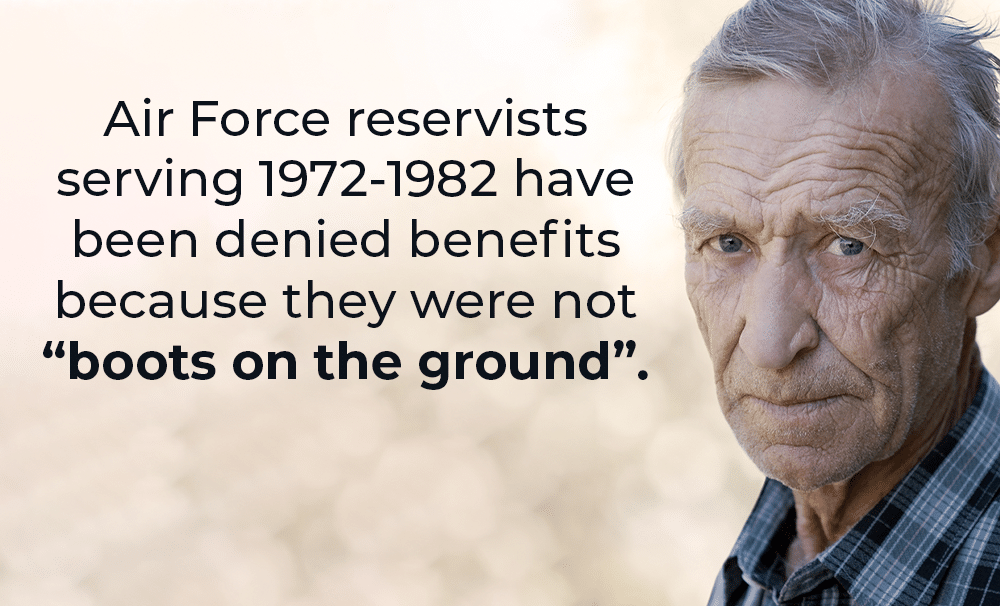
Approximately 1,500 to 2,100 U.S. Air Force and Air Force Reserve personnel worked and trained as flight, medical and ground maintenance crew on C-123 aircraft that had been used to spray herbicides in Vietnam as part of Operation Ranch Hand, and which still had residual dioxins. These Air Force reservists suffered the same adverse health effects as Vietnam veterans, but their claims were denied because they were not “boots on the ground” and the VA didn’t know if they could have been exposed to Agent Orange on the C-123 aircraft years after the planes were used to spray the chemical.
Recognizing Agent Orange Exposure for C-123 Aircraft Personnel
Tasked by the VA to study possible exposure to Agent Orange of the Air Force reservists who worked on C-123 aircraft, the Institute of Medicine (IOM) released a public health report relating to health effects of Agent Orange exposure, called the Post-Vietnam Dioxin Exposure Agent Orange-Contaminated C-123 Aircraft. The report, published in January 2015, found plausible evidence that Air Force Reservists who crewed or maintained contaminated C-123s were exposed to herbicide residues at levels that could cause health problems.
- Crew members were likely exposed to herbicide residues through aerosolized particles and surface contact inside the aircraft.
- Although precise exposure levels could not be reconstructed, it was plausible that concentrations exceeded accepted health guidelines for enclosed occupational settings.
- Exposure could have led to non-trivial increases in risk for diseases associated with Agent Orange exposure.
As a result of the IOM’s conclusions, the VA issued an interim rule on June 19, 2015, expanding the presumption of herbicide exposure to include Air Force and Air Force Reserve personnel who regularly operated, maintained, or trained on contaminated C-123 aircraft. The presumption was included in the VA’s official regulations.
Who Benefits from the VA Presumption Rule?
Air Force Reserve personnel included maintenance and flight crews, either as Reservists or as Air Reserve Technicians. The flight crew included a pilot, navigator, flight engineer, and a loadmaster. In addition to the flight crew, maintenance personnel, paratroopers, and aero-medical personnel (including nurses) all had duties which could have brought them in contact with C-123s formerly used in Operation Ranch Hand. Under the regulation, the VA presumes Agent Orange exposure for veterans who:
- Had regular contact during the unit/location service-date windows (generally 1969–1986)
- Regularly and repeatedly operated, maintained, or trained aboard C-123 aircraft that were used in Vietnam to spray herbicides
- Served at specific locations where those aircraft were assigned
Qualifying Specialty Codes
- Officers: Pilots, Navigators, Flight Nurses (Codes 1041–1055, 1111, 9761–9766)
- Enlisted: Flight Engineers, Loadmasters, Aircraft Maintenance, Life Support (Codes 11300–11490, 43010, 43100, 12200–12290)
Eligible Units
Active Duty
Veterans who developed an Agent Orange related disability are presumed to have been exposed if they served in the United States Air Force at a location where a contaminated C-123 was assigned and who had regular contact with the C-123 aircraft through ground, medical, or flight duties between 1962 and 1986 (the period of service varies for each location).
| Base location | Unit | Service dates |
| Hurlburt Auxiliary Field, Eglin Air Force Base, Florida | 1st Special Operations Squadron | 1968 |
| Hurlburt Auxiliary Field, Eglin Air Force Base, Florida | 1st Special Operations Wing | 1970 to 1973 |
| Hurlburt Auxiliary Field, Eglin Air Force Base, Florida | 4410th Combat Crew Tactical Wing [Ferry Flights] | 1970 to 1973 |
| Luke Air Force Base, Arizona | 56th Air Base Wing | 1970 to 1973 |
| England Air Force Base, Louisiana | 401st Tactical Fighter Wing | 1965 |
| England Air Force Base, Louisiana | 1st Air Commando Wing | 1966 |
| England Air Force Base, Louisiana | 319th Air Commando Squadron | 1966 |
| Langley Air Force Base, Virginia | 4500th Air Base Wing | 1962 to 1963, 1965, 1970 to 1973 |
| Hayes Aircraft Facility, Napier Field, Dothan, Alabama | Air Force Logistic Command | 1970 to 1976 |
| Davis-Monthan Air Force Base, Arizona | Aerospace Maintenance and Regeneration Center | 1970 |
| Davis-Monthan Air Force Base, Arizona | Military Aircraft Service and Disposal Center | 1970 to 1986 |
| Tainan Airfield, Taiwan | 309th Special Operations Squadron | 1969 to 1970 |
| Tainan Airfield, Taiwan | 310th Special Operations Squadron | 1969 to 1970 |
| Howard Air Force Base, Panama | 24th Special Operations Wing | 1970 to 1973 |
| Osan Air Base, South Korea | 51st Air Base Wing | 1970 to 1973 |
| Clark Air Force Base, Philippines | 405th Fighter Wing | 1973 |
| Thailand (including all Air Bases, such as Nakhon Phanom Royal Thai Air Force Base and Don Muang Royal Thai Air Force Base) | 56th Special Operations Wing | 1967 to 1971 |
Reservists
Reservists are eligible if they worked on ground, medical, or flight crews at:
- Lockbourne/Rickenbacker Air Force Base, Ohio (from 1969 to 1986) – 302nd Tactical Airlift Wing, 901st, 906th and 907th Tactical Air Groups, 355th and 356th Tactical Airlift Squadrons, 4413th Combat Crew Tactical Wing [Ferry Flights]
- Westover Air Force Base, Massachusetts (from 1972 to 1982) – 731st Tactical Air Squadron, 74th Aeromedical Evacuation Squadron, 439th Tactical Airlift Wing, 901st Organizational Maintenance Squadron
- Pittsburgh International Airport, Pennsylvania (from 1972 to 1982) – 758th Airlift Squadron, 911th Tactical Air Group, 911th Aircraft Maintenance Squadron and 911th Aeromedical Evacuation Squadron

What The VA Presumption Means for You
The C-123 presumption closed a major gap in Agent Orange policy. Air Force and Reserve personnel who worked aboard these aircraft qualify under VA’s C-123 presumption policy (and may also benefit from PACT Act expansions depending on conditions/exposures). As of early August 2025, VA reported about 74% approval among completed PACT Act–related claims.
If you served with a qualifying unit and later developed a disease on the presumptive list but the VA has denied you disability, you should file an appeal to get the benefits you deserve.
Because herbicide exposure has uniquely latent effects, VA will presume that an Agent Orange related condition had its onset during the service. The medical conditions that have been determined by VA to be related to exposure to Agent Orange include diabetes mellitus, ischemic heart disease, Parkinson’s disease, early-onset peripheral neuropathy, prostate cancer, respiratory cancers, and others. See all Agent Orange presumptive conditions.
Next Steps
- Register with the Agent Orange Registry for a free health exam and exposure documentation
- Contact an Environmental Health Coordinator at your VA medical center to discuss symptoms or exposure concerns
- Gather medical records and test results to support any current or future claims and get a free evaluation of your case
- File a claim for disability benefits or appeal the existing VA decision. Survivors whose spouses died from an Agent Orange related disease should claim Dependency and Indemnity Compensation.
Written by